
Standing Soldiers and Kneeling Figures
n.d.
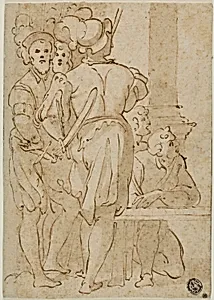
Medium
Pen and brown ink, with brush and brown wash, and red chalk, on ivory laid paper, laid down on ivory card
Dimensions
18.9 × 13.3 cm (7 1/2 × 5 1/4 in.)
Classification
ink with wash
Department
Prints and Drawings
Museum
Art Institute of Chicago
Accession Number
85696
Rights
Public Domain
Art Historical Context
Taddeo Zucc, a leading Italian Mannerist artist of the mid-16th century, *Standing Soldiers and Kneeling*, a dynamic preparatory drawing that captures the tension and drama typical of his style. Active in Rome during the height of the Renaissance's evolution into Mannerism, Zuccaro was renowned for his frescoes in papal palaces and his fluid, expressive draftsmanship. This undated work, housed in the Art Institute of Chicago's Prints Drawings Department, exemplifies his skill in sketching figures with energetic poses—soldiers standing assertively alongside kneeling forms—likely studies for larger narrative compositions. Executed on ivory laid paper (18.9 × 13. cm) and laid down on ivory card for preservation, the drawing employs a rich mixed media: pen and brown ink for precise contours, brush and brown wash for subtle tonal modeling, and red chalk for accents that add warmth and volume. These techniques, common in 16th-century workshops, allowed artists like Zuccaro to explore composition, light, and movement before committing to paint or fresco. The intimate scale invites close viewing, revealing the artist's masterful linework and innovative layering. As a classified "ink with wash" piece, it highlights the centrality of drawings in Mannerist practice—not mere sketches, but autonomous works of art valued for their spontaneity and sophistication. Visitors will appreciate how Zuccaro's figures evoke the era's theatrical humanism, bridging Renaissance naturalism with Mannerism's elegant distortion.
About the Artist
Taddeo Zuccaro · 1529–1566
Taddeo Zuccaro, born on September 1, 1529, in Sant'Angelo in Vado within the Duchy of Urbino, emerged from a modest artistic family as the son of the little-known painter Ottaviano Zuccaro, in whose workshop he received his initial training. Encouraged by the local artist Pompeo da Fano, who served briefly as his teacher according to Giorgio Vasari, Taddeo relocated to Rome around age 14, where he...