
Star-Shaped Tile
Unknown Artist
dated A.H. 661/1262–63 CE
Medium
Stonepaste; luster-painted on opaque white glaze
Dimensions
Max. H. (point to point) 12 9/16 in. (31.9 cm) W. 11/16 in. (1.7 cm)
Classification
Ceramics-Tiles
Department
Islamic Art
Museum
Metropolitan Museum of Art, New York, NY
Credit
Edward C. Moore Collection, Bequest of Edward C. Moore, 1891
Accession Number
91.1.100
Rights
Public Domain
Tags
Art Historical Context
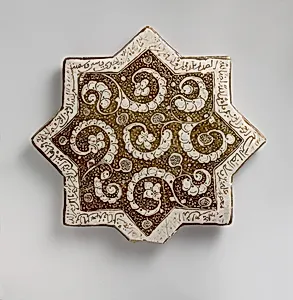
This exquisite star-shaped tile, dated A.H. 661 (1262–63 CE), hails from the Islamic world during a golden age of ceramic innovation, likely produced in regions like Syria or Iran under Seljuk or early Mongol patronage. Measuring about 12½ inches from point to point, it exemplifies the architectural tiles that adorned mosques, madrasas, and palaces, forming intricate geometric patterns that evoked the cosmos and divine order. Its star form reflects the Islamic passion for symmetry and astronomy, where such motifs symbolized the heavens and eternity. Crafted from stonepaste—a composite of quartz, clay, and glass frit—this tile features luster-painting on an opaque white glaze, a sophisticated technique perfected by Islamic potters. The metallic luster, achieved through multiple firings with copper and silver oxides, creates a shimmering, jewel-like glow that mimics precious metals. This labor-intensive method, revived after earlier Abbasid traditions, highlighted the era's technical mastery and elevated ceramics to rival luxury imports. Today, housed in the Metropolitan Museum of Art's Islamic Art collection, this tile invites us to marvel at medieval ingenuity. Its Arabic inscriptions (now faded) likely bore blessings or poetry, bridging art, faith, and daily life in a vibrant multicultural society. A testament to enduring beauty, it reminds visitors of Islam's profound contributions to global design.