
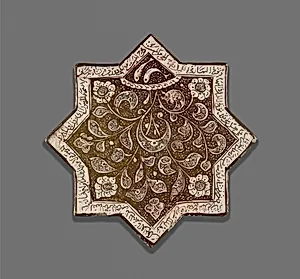
Star-Shaped Tile with Qur'anic Inscriptions
Ilkhanid dynasty (1256–1353), Mid-13th century
Medium
Lusterware, fritware painted in lustre over an opaque white glaze
Dimensions
31.6 × 31.3 × 1.3 cm (12 7/16 × 12 5/16 × 1/2 in.)
Classification
earthenware
Department
Arts of Asia
Museum
Art Institute of Chicago
Accession Number
71231
Rights
Public Domain
About this artwork
These star and cross-shaped luster tiles were originally part of the dado (lower part of the wall) decoration of the mausoleum of a holy man in Varamin, Iran. Tiles in these two shapes were fitted together to form a continuous panel of decoration. Appropriate for a religious context, each tile features vegetal patterns framed by Qur'anic inscription and is devoid of figural representation.These tiles belong to a larger group of about 150 luster-painted tiles attributed to the mausoleum in Varami...
About the Artist
Islamic
Islamic art, a profound visual tradition originating in the 7th century CE, flourished across vast territories from Spain to India under Muslim rule, encompassing architecture, ceramics, manuscripts, textiles, and metalwork produced by diverse artisans rather than a single named master. Drawing from pre-Islamic Sasanian, Byzantine, and late antique influences, its early development under the Umayy...