
Statue of Deified Amenhotep I
A.D. 1922; original ca. 1279–1213 B.C.
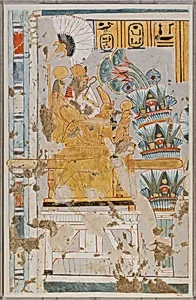
Medium
Tempera on paper
Dimensions
Facsimile H. 65.5 cm (25 13/16 in.); w. 41.5 cm (16 5/16 in.); scale 1:1; Framed H. 69.2 cm (27 1/4 in.); w. 45.4 cm (17 7/8 in.)
Classification
Facsimile, Panehsy (TT 16), Amenhotep I, palanquin, sphinx; Drink-and-be-Merry
Period
Twentieth Century; original New Kingdom
Department
Egyptian Art
Museum
Metropolitan Museum of Art, New York, NY
Credit
Rogers Fund, 1930
Accession Number
30.4.5
Rights
Public Domain
Tags
Art Historical Context
This exquisite facsimile, titled *Statue of Deified Amenhotep I*, captures the divine reverence for one of ancient Egypt's revered pharaohs. Created in 1922 by Nina de Garis Davies, pioneering artist renowned for her meticulous watercolor copies of Egyptian tomb decorations, it replicates a New Kingdom wall painting from Dynasty 19 (ca. 1279–1213 B.C.). Rendered in tempera on paper at a 1:1 scale (65.5 x 41.5 cm), the work preserves the original's vibrant colors and intricate details, now housed in the Metropolitan Museum of Art's Egyptian Art department through the Rogers Fund of 1930. Amenhotep I, ruler of Dynasty 18 (ca. 1525–1504 B.C.), was deified after death, becoming a god of fertility and healing, often paired with his mother Ahmose-Nefertari. This depiction from the later Ramesside period reflects his enduring cult worship, showcasing royal iconography like idealized features, nemes headdress, and divine attributes that symbolized eternal power and protection. Such images adorned tombs, invoking the pharaoh's blessings for the afterlife. Davies's technique—layered tempera for luminous hues and fine brushwork—brings the ancient fresco's faded glory back to life, offering modern viewers an unparalleled window into Egyptian artistry. A testament to early 20th-century Egyptology, it highlights how facsimiles safeguard fragile heritage while revealing the culture's blend of piety and grandeur.
About the Artist
Nina de Garis Davies · 1881–1965
Nina de Garis Davies, born Anna Macpherson Cummings on January 6, 1881, in Salonika, Greece, to English-Scottish parents Cecil J. Cummings and Sarah Macintosh Tannoch, showed early artistic talent as the eldest of three daughters. After her father's death in 1894, the family relocated to Scotland and then London, where she trained at the Slade School of Art. In 1906, at age 25, a holiday trip to E...