
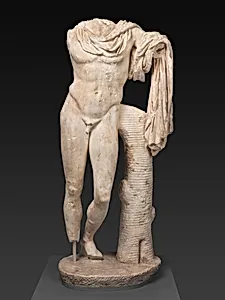
Statue of Meleager
1st-2nd century
Medium
Marble
Dimensions
173 × 73.7 × 55.2 cm (68 5/16 × 29 × 21 3/4 in.)
Classification
sculpture
Department
Arts of Greece, Rome, and Byzantium
Museum
Art Institute of Chicago
Accession Number
40593
Rights
Public Domain
About this artwork
The statue depicts the legendary Greek hunter Meleager, who earned his fame by killing a ferocious boar that terrorized the people of Calydon. About forty Roman sculptural representations of Meleager survive, leading scholars to conclude that there was likely an earlier Greek statue on which they are based, presumably by the architect and sculptor Skopas of Paros, who incorporated a marble relief depicting the Calydonian boar hunt on one of his buildings. However, none of the ancient authors who...
Art Historical Context
Behold the **Statue of Mele**, a commanding Ancient Roman marble sculpture from the 1st-2nd century AD, now gracing the Arts of Greece, Rome, Byzantium department at the Art Institute of Chicago Standing an impressive 173 cm tall (nearly 5 feet 8 inches), this life-sized figure captures the heroic ideal of classical antiquity, carved from fine white marble that gleams with polished elegance. Meleager, the legendary Greek hunter celebrated in mythology for slaying the Calydonian Boar, Roman artistry's reverence for Hellenistic prototypes. Sculptors of this era excelled in transforming hard marble into supple, anatomically precise forms, often drilling deep curls for hair and veins to mimic the lost-wax bronze originals they copied. The statue's contrapposto stance—weight shifted to one leg—conveys dynamic tension and poised strength, a hallmark of Greco-Roman mastery. This work reflects Rome's cultural fusion of Greek myths with imperial grandeur, serving as both decorative statement and testament to artistic patronage. Visitors are drawn to its timeless allure, inviting reflection on heroism across millennia.
About the Artist
Ancient Roman
The artists attributed to "Ancient Roman" in museum collections represent the anonymous craftsmen who produced the vast output of sculpture, frescoes, mosaics, and reliefs defining Roman visual culture from the Republic (c. 509–27 BCE) to the late Empire (c. 395 CE). Individual identities remain elusive, as Roman makers were typically viewed as skilled tradesmen—often enslaved Greeks or provincial...