
Statue of Ptah-Sokar-Osiris
Ptolemaic Period (332–30 BCE)
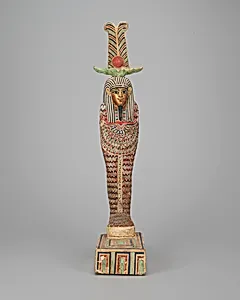
Medium
Wood, preparation layer, pigment, gold, and textile
Dimensions
62.9 × 12.7 × 27.3 cm (24 3/4 × 5 × 10 3/4 in.)
Classification
statue
Department
Arts of Africa
Museum
Art Institute of Chicago
Accession Number
160171
Rights
Public Domain
About this artwork
Divine images, powerful symbols, and sacred words placed in the burial chamber with the deceased helped ancient Egyptians transition from the earthly realm to the afterlife. This funerary statue, owned by a woman named Asetirdis (“Isis is the one who gave her”), depicts the god Ptah-Sokar-Osiris. A composite of Ptah (a creator god), Sokar (the patron deity of the necropolis west of Memphis), and Osiris (the ruler of the underworld), Ptah-Sokar-Osiris’s purview encompassed all phases of life, inc...
Art Historical Context
This elegant wooden statue of Ptah-Sokar-Osiris dates to Egypt’s Ptolemaic Period (332–30 BCE), when Greek rulers governed the Nile Valley yet Egyptian religious traditions remained deeply rooted. The composite deity merges Ptah, the creator of Memphis, with Sokar, patron of Memphite necropolis, and Osiris, lord of the afterlife. Such figures were placed in tombs to ensure the deceased’s resurrection and eternal protection, reflecting the enduring Egyptian belief in divine mediation between the living and the dead. Crafted from wood coated with a preparation layer, pigment, gold leaf, and textile, the statue demonstrates sophisticated funerary artistry. The use of precious gold and vibrant pigments not only honored the god’s divine status but also helped preserve the figure through symbolic and practical means. Its compact scale—roughly two feet tall—suggests it was designed for intimate tomb settings rather than grand temple display. Today housed in the Art Institute of Chicago’s Arts of Africa collection, the work offers visitors a tangible link to the final centuries of ancient Egyptian civilization, when time-honored iconography continued to flourish under foreign rule.
About the Artist
Ancient Egyptian
Ancient Egyptian artists, a collective of highly skilled artisans spanning over three millennia from the Predynastic period (c. 6000–3150 BC) to the Roman era (30 BC–4th century AD), produced some of humanity's most enduring masterpieces. These anonymous craftsmen, often organized in state-sponsored workshops, lived in dedicated communities like Deir el-Medina near Luxor during the New Kingdom (c....