
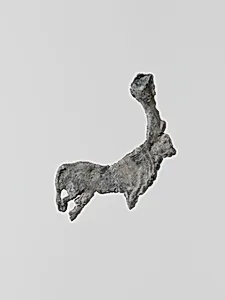
Statuette of a bull
Unknown Artist
Medium
Lead
Dimensions
Height: 1 7/16 in. (3.7 cm)
Classification
Miscellaneous-Lead
Culture
Greek, Laconian
Department
Greek and Roman Art
Museum
Metropolitan Museum of Art, New York, NY
Credit
Gift of A. J. B. Wace, 1924
Accession Number
24.195.117
Rights
Public Domain
Tags
Art Historical Context
This diminutive **Statuette of a Bull**, crafted from lead and standing just 1 7/16 inches (3.7 cm) tall, hails from ancient Laconian Greece—the rugged region of Sparta known for its warrior culture and austere artistry. Donated to the Metropolitan Museum of Art in 1924 by archaeologist A. J. B. Wace, this rare piece belongs to the museum's Greek and Roman Art, classified among miscellaneous lead objects. Its small scale and malleable medium suggest it was likely a votive offering personal amulet, or even a toy, common in ancient sanctuaries where devotees left such tokens to honor the gods. Lead, though softer and less prestigious than bronze or marble, was prized for its affordability and ease of casting, allowing intricate details on everyday devotional items. In Laconian workshops, artisans might have molded the bull's sturdy form using simple lost-wax techniques or direct pouring, capturing the animal's powerful stance with surprising vitality despite the material's humility. Bulls held profound cultural weight in Greek mythology and religion, symbolizing strength, fertility, and divine power—think Zeus's abduction of Europa or Poseidon's earthly avatar. This statuette evokes those timeless associations, offering a glimpse into the spiritual lives of ordinary Laconians who revered such beasts in rituals at sites like the Sanctuary of Artemis Orthia. A charming survivor from antiquity, it reminds us how even tiny artifacts bridge us to the ancient world.