
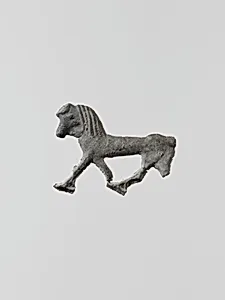
Lead figure of a horse
Unknown Artist
6th–5th century BCE
Medium
Lead
Dimensions
Length: 1 3/16 in. (3.1 cm)
Classification
Miscellaneous-Lead
Culture & Period
Greek, Laconian · Archaic
Department
Greek and Roman Art
Museum
Metropolitan Museum of Art, New York, NY
Credit
Gift of A. J. B. Wace, 1924
Accession Number
24.195.102
Rights
Public Domain
Tags
Art Historical Context
This diminutive lead figure of a, crafted in Laconian Greece during the Archaic period (6th–5th century BCE), offers a glimpse into the everyday artistry of ancient Sparta's region. Measuring just 1 3/16 inches (3.1 cm) long, it exemplifies the small-scale metalwork produced in workshops where lead—a soft, malleable metal—was favored for its affordability and ease of casting compared to pricier bronze. Donated to the Metropolitan Museum of Art in 1924 by archaeologist A. J. B. Wace, this rare survivor highlights the fragility and preciousness of such artifacts. In Archaic Greece, horses symbolized speed, power, and nobility, often linked to warfare and elite status in Laconian culture, home to the militaristic Spartans. Though classified as miscellaneous, this figure likely served a practical or ritual purpose, such as a votive offering, toy, or amulet, reflecting the period's blend of functionality and symbolism. Its simple, solid form captures the era's early sculptural style—geometric yet hinting at naturalism—before the Classical ideals of proportion took hold. Visitors, imagine holding this tiny equine treasure, a bridge to the rugged world of ancient Laconia where such objects brought the divine or heroic into daily life.