
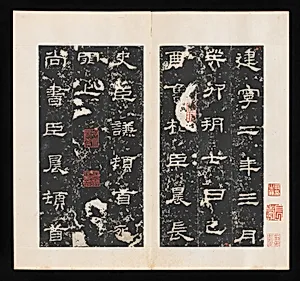
清拓 《史晨碑》 冊 十九世紀拓本|Stele for Shi Chen
19th century rubbing; stele dated 169 CE
Medium
Rubbing mounted in an album of thirty-two leaves; ink on paper
Dimensions
Image: 10 7/8 x 5 5/8 in. (27.6 x 14.3 cm) Overall with mounting: 13 7/8 x 7 7/16 in. (35.2 x 18.9 cm)
Classification
Rubbing
Culture & Period
China · Qing dynasty (1644–1911)
Department
Asian Art
Museum
Metropolitan Museum of Art, New York, NY
Credit
Gift of Mr. and Mrs. Wan-go H. C. Weng, 1992
Accession Number
1992.166.2a–ff
Rights
Public Domain
Art Historical Context
This exquisite 19th-century rubbing of the *Stele for Shi Chen*, dated to 169 CE, captures the elegant calligraphy of an Eastern Han dynasty monument in ink on paper, mounted within an album of thirty-two leaves. Created during China's Qing dynasty (1644–1911), this artwork exemplifies the traditional rubbing technique, where dampened paper is pressed against an inscribed stone surface and inked to transfer its text and artistry precisely. Measuring about 11 x 5.5 inches per image, it invites viewers to appreciate the stele's refined lines up close. Rubbings like this were highly prized in imperial China for preserving ancient inscriptions that might erode over time, serving scholars, collectors, and calligraphers as portable archives of history and aesthetics. The *Shi Chen Stele* represents early mastery of regular script (kaishu), a pivotal style that influenced Chinese writing for centuries. Part of the Metropolitan Museum of Art's Asian Art collection, this piece was generously gifted by Mr. and Mrs. Wan-go H. C. Weng in 1992, offering modern visitors a tangible link to Han-era artistry. (198 words)