
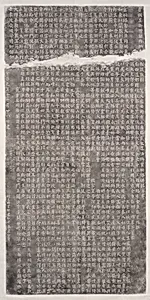
唐 柳公權 玄秘塔碑(現代拓片)|Stele of the Xuanmi Pagoda
Unknown Artist
20th century
Medium
Twentieth-century rubbing of a stele carved in 841; ink on paper
Dimensions
Image: 95 1/4 × 46 1/4 in. (241.9 × 117.5 cm)
Classification
Rubbing
Culture
China
Department
Asian Art
Museum
Metropolitan Museum of Art, New York, NY
Credit
Seymour and Rogers Funds, 1977
Accession Number
1977.375.17
Rights
Public Domain
Art Historical Context
Welcome to the Metropolitan Museum of's Asian Art collection, where we present a twentieth-century rubbing of the *Stele of the Xuanmioda* (玄秘塔碑), originally carved in 841 during China's Tang dynasty (618–907). This ink-on-paper reproduction captures elegant calligraphy attributed to Liu Gongquan (778–865), one of the's master calligraphers. Measuring an impressive 95¼ × 46¼ inches, it invites visitors to marvel at the stele's towering presence, as if stepping into a Tang temple courtyard. Liu Gongquan's inscription commemorates the Xuanmi Pagoda, blending historical record with artistic mastery in the regular script (kaishu) style. Known for its balanced structure, vigorous strokes, and rhythmic flow—often called "Liu's bone strength"—his work epitomized Tang ideals of harmony and imperial grandeur. The Tang dynasty was a golden age for calligraphy, with steles like this serving as public monuments that preserved poetry, biographies, and dedications for posterity. Rubbings, or *topie*, are a cherished Chinese technique: damp paper is pressed against the carved stone, then inked to transfer the textured inscription. This modern version, acquired in 1977 through the Seymour and Rogers Funds, allows us to experience an 9th-century treasure without wear on the original. It highlights rubbings' role in transmitting cultural heritage, making ancient artistry accessible across centuries.