
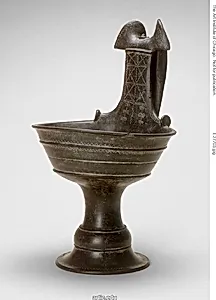
Stemmed Kyathos (Drinking Cup)
550-525 BCE
Medium
terracotta, bucchero ware
Dimensions
42 × 27 × 25.2 cm (16 5/8 × 10 5/8 × 9 7/8 in.)
Classification
drinking vessel
Department
Arts of Greece, Rome, and Byzantium
Museum
Art Institute of Chicago
Accession Number
60837
Rights
Public Domain
About this artwork
A unique legacy of the Etruscans is the glossy black pottery known as Bucchero ware, made from the 7th century to the late 5th century B.C. Produced for both domestic and funerary uses, Bucchero ware was popular locally and imported across the Mediterranean. The signature shiny black surface was achieved by firing the pottery in a reduced-oxygen kiln, where restricted ventilation caused the iron oxide in the coarse Tuscan clay to turn black. Before firing, the clay was burnished, or polished wit...
Art Historical Context
This elegant stemmed kyathos, a deep drinking cup favored in ancient banquets, hails from the Etruscan civilization of central Italy around 550-525 BCE. Crafted from terracotta in the distinctive bucchero ware technique, measures an impressive 42 × × 25.2 cm, showcasing the Etruscans' mastery of pottery that mimicked the sheen of luxury bronze vessels. The glossy black surface, achieved through a reduction firing process in a smoke-filled kiln, gave bucchero its metallic luster, making it a status symbol for elite households. Etruscan artisans excelled in bucchero during the Archaic period, blending local innovation with Greek influences evident in the kyathos form—a stemmed bowl ideal for sipping wine or dipping. These vessels were essential to symposia-like gatherings, reflecting the Etruscans' sophisticated social and funerary rituals. Often found in tombs, they highlight a culture that prized feasting and the afterlife. Housed in the Art Institute of Chicago's Arts of Greece, Rome, and Byzantium department, this kyathos offers a window into pre-Roman Italy's vibrant world, where pottery bridged everyday life and artistry. Its preservation reveals the enduring allure of Etruscan craftsmanship.