
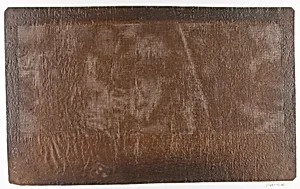
Stencil
Unknown Artist
19th century
Medium
Paper
Dimensions
16 1/4 x 10 1/2 in. (41.3 x 26.7 cm)
Classification
Stencils
Culture & Period
Japan · Edo period (1615–1868)
Department
Asian Art
Museum
Metropolitan Museum of Art, New York, NY
Credit
Purchase, Mrs. Helen M. Meserve Gift, 1981
Accession Number
1981.10.45
Rights
Public Domain
Art Historical Context
This delicate stencil from 19th-century Japan, crafted during the Edo period (1615–8), exemplifies the ingenuity of traditional Japanese craft. Made of paper and measuring 16¼ x 10½ inches, it belongs to a category of tools known as *katagami*, used by artisans to create intricate patterns on textiles like kimonos. The Edo era was a golden age of urban culture in Japan, where a thriving merchant class fueled demand for affordable, beautifully dyed fabrics, transforming everyday clothing into wearable artStencil-making was a masterful technique involving thin mulberry paper (*washi*) meticulously cut with fine knives or chisels, often by folding the sheet to produce symmetrical motifs inspired by nature, theater, or daily life. Applied with rice paste as a resist in the *katazome* dyeing process, these stencils allowed for precise, repeatable designs on silk or cotton, democratizing elaborate aesthetics beyond the elite. Housed in the Metropolitan Museum of Art's Asian Art Department (purchased with the Mrs. Helen M. Meserve Gift in 1981), this anonymous work highlights the fusion of utility and artistry in Edo Japan, where craftsmanship rivaled painting and printmaking in sophistication. Visitors can appreciate how such tools powered the vibrant fashion scene of old Tokyo.