
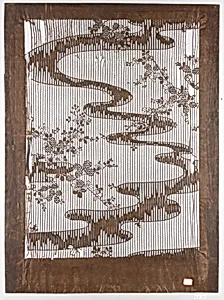
Stencil for Textile with Pattern of Bush Clover and Meandering Stream
Unknown Artist
19th century
Medium
Paper reinforced with silk
Dimensions
23 x 17 in. (58.4 x 43.2 cm)
Classification
Stencils
Culture
Japan
Department
Asian Art
Museum
Metropolitan Museum of Art, New York, NY
Credit
Gift of Mrs. Horace Havemeyer, 1942
Accession Number
42.91.225
Rights
Public Domain
Tags
Art Historical Context
This delicate stencil, titled *Stencil for Textile with Pattern of Bush Clover and Meandering Stream*, hails from 19th-century Japan and exemplifies the intricate craftsmanship of katagami, traditional stencils used in textile printing. Crafted from paper reinforced with silk for durability, it measures 23 x 17 inches and was designed to transfer repeating motifs onto fabrics like kimonos via resist-dyeing techniques such as katazome. The reinforcement with silk allowed these stencils to withstand repeated use, preserving their fine details over time. The design features bush clover (lespedeza), a flower symbolizing autumn's fleeting beauty in Japanese culture, intertwined with a gently meandering stream evoking the flow of water and life's transience—core themes in traditional motifs. These nature-inspired patterns reflect Japan's reverence for seasonal change and harmony with the environment, often adorning everyday garments and elevating ordinary textiles into art. Now housed in the Metropolitan Museum of Art's Asian Art Department as a gift from Mrs. Horace Havemeyer in 1942, this stencil offers a window into Edo- and Meiji-period artisanal techniques. Its precision-cut lines highlight the anonymous artist's mastery, bridging functional craft and aesthetic elegance in Japanese decorative arts.