
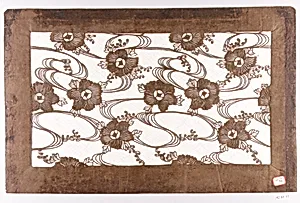
Stencil with Pattern of Open Flowers on Water
Unknown Artist
19th century
Medium
Paper reinforced with silk
Dimensions
10 5/8 x 16 3/4 in. (27.0 x 42.5 cm)
Classification
Stencils
Culture
Japan
Department
Asian Art
Museum
Metropolitan Museum of Art, New York, NY
Credit
Gift of Mrs. Horace Havemeyer, 1942
Accession Number
42.91.77
Rights
Public Domain
Tags
Art Historical Context
This delicate 19th-century Japanese, titled *Stencil with Pattern of Open Flowers on Water showcases the intricate artistry of anonymous craftsmen from the Asian Art tradition. Crafted from paper meticulously reinforced with silk threads, measures 10 5/8 x 16 3/4 inches, making it a portable yet robust tool for textile decoration. The open floral motifs floating on water evoke the serene beauty of nature, recurring theme in Japanese design that symbolizes purity and transience. Known as *katagami*, these stencils were essential in the *katazome* dyeing technique, where rice paste was applied through the cutouts onto fabric—often luxurious kimonos—before pigmenting. The silk reinforcement allowed for repeated use without tearing, highlighting the technical ingenuity of Edo- and early Meiji-period artisans. Such patterns influenced fashion and decorative arts, bridging folk craft with high art. A generous gift to the Metropolitan Museum of Art from Mrs. Horace Havemeyer in 1942, this piece invites visitors to appreciate the precision and poetic elegance of Japan's stencil-making heritage, where everyday tools doubled as masterpieces of design.