
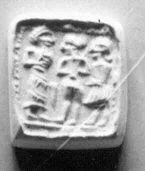
Stepped pyramidal seal with loop handle
Unknown Artist
ca. 18th century BCE (?)
Medium
Steatite, black
Dimensions
Seal Face: 1.45 x 1.42 cm Height: 1.38 cm remaining String Hole: 0.1 cm (broken)
Classification
Stone-Stamp Seals
Culture & Period
Syrian · Middle Bronze Age (?)
Department
Ancient Near Eastern Art
Museum
Metropolitan Museum of Art, New York, NY
Credit
Purchase, 1899
Accession Number
99.22.18
Rights
Public Domain
Tags
Art Historical Context
This petite stepped pyramidal seal, crafted from glossy black steatite around the 18th century BCE, exemplifies the exquisite miniature artistry of Middle Bronze Age Syria. Measuring just 1.45 x 1.42 cm across its seal face and standing 1.38 cm tall (with a broken string hole it features a loop handle for suspension on a cord, allowing it to be worn or to documents and goods. Steatite, a softstone, was prized for its carvability, enabling intricate designs like the human figures etched on its face—likely scenes of daily life, ritual, or authority. In ancient Syrian culture, stamp seals like this were essential tools for administration and trade, impressing their raised designs into soft clay to authenticate ownership, contracts, or shipments across the bustling Near Eastern networks. The stepped pyramidal form is a hallmark of regional styles, symbolizing perhaps architectural motifs or cosmic order, and reflects the sophisticated lapidary techniques of the era, where tiny surfaces conveyed profound social meaning. Acquired by the Metropolitan Museum of Art in 1899, this fragile artifact offers a window into a world of portable power and precision craftsmanship, reminding us how even the smallest objects sealed the fates of empires.