
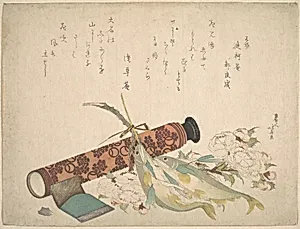
Still Life: Double Cherry-Blossom Branch, Telescope, Sweet Fish, and Tissue Case
ca. 1804–13
Medium
Woodblock print (surimono); ink and color on paper
Dimensions
8 1/8 x 10 11/16 in. (20.6 x 27.1 cm)
Classification
Prints
Culture & Period
Japan · Edo period (1615–1868)
Department
Asian Art
Museum
Metropolitan Museum of Art, New York, NY
Credit
H. O. Havemeyer Collection, Bequest of Mrs. H. O. Havemeyer, 1929
Accession Number
JP1870
Rights
Public Domain
Tags
Art Historical Context
In the vibrant world of Edo-period Japan (1615–1868), Katsushika Hokusai crafted this exquisite *Still Life: Double Cherry-Bloss Branch, Telescope, Sweet Fish, and Tissue Case around 1804–13. A master of ukiyo-e—"pictures of the floating world"—okusai is best known for dynamic landscapes like *The Great Wave off Kawa*, but this intimate woodblock print showcases his early versatility in still life compositions. Printed as a *surimono*, a luxurious, privately commissioned format often exchanged as New Year's greetings, it measures just 8⅛ x 10⅞ inches, perfect for personal appreciation. The scene delicately balances natural and imported elements: delicate cherry blossoms evoke hanami traditions and life's fleeting beauty; a shimmering ayu (sweet fish), a summer delicacy; a Western telescope hinting at Japan's curiosity about Dutch trade during sakoku isolation; and a patterned tissue case adding everyday elegance. Fine ink and color on paper, achieved through precise woodblock carving and subtle embossing, highlight Hokusai's technical brilliance, with poetry likely inscribed to blend art and literature—a hallmark of surimono culture. Housed in the Metropolitan Museum of Art's H. O. Havemeyer Collection, this print reflects Edo Japan's fusion of tradition and novelty, inviting viewers to ponder impermanence amid beauty. A rare still life from Hokusai's prolific output, it reveals the artist's playful experimentation before his later fame.
About the Artist
Katsushika Hokusai · 1760–1849
Katsushika Hokusai (1760-1849) stands as one of history's most influential artists, a Japanese master who revolutionized the ukiyo-e woodblock print tradition and profoundly shaped Western art. Born in the Katsushika district of Edo (modern-day Tokyo) to an artisan family, Hokusai lived through nearly nine decades of extraordinary creative evolution, adopting over thirty different artistic names t...