
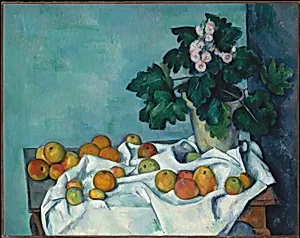
Still Life with Apples and a Pot of Primroses
ca. 1890
Medium
Oil on canvas
Dimensions
28 3/4 x 36 3/8 in. (73 x 92.4 cm)
Classification
Paintings
Department
European Paintings
Museum
Metropolitan Museum of Art, New York, NY
Credit
Bequest of Sam A. Lewisohn, 1951
Accession Number
51.112.1
Rights
Public Domain
Tags
Art Historical Context
Paul Cézanne's *Still Life with Apples and Pot of Primroses created around 1890, exemplifies the Post-Impressionist's revolutionary approach to everyday subjects. As a master of the still life genre, Céz transformed simple fruits and flowers—here, vibrant apples and delicate primroses in a modest pot—into profound studies of form and space. Working in oil on canvas, a medium he wielded with bold, constructive brushstrokes, he rejected the fleeting light of Impressionism in favor of solid, geometric volumes that prefigured Cubism. This painting, now at the Metropolitan Museum of Art, captures Cézanne's innovative technique: subtle shifts in perspective create a sense of depth without traditional illusionism, inviting viewers to experience the objects from multiple angles. Painted during his mature period in Provence, it reflects his obsession with apples as symbols of stability amid change, bridging 19th-century traditions with modern abstraction. A bequest from collector Sam A. Lewisohn in 1951, it remains a cornerstone of European painting collections, reminding us how Cézanne elevated the ordinary to timeless art.
About the Artist
Paul Cézanne · 1839–1906
Paul Cézanne (1839-1906) stands as one of the most influential figures in the history of modern art, often called the "Father of Modern Art" for his revolutionary approach to form, color, and pictorial space. Born in Aix-en-Provence to a wealthy banker who discouraged artistic pursuits, Cézanne rejected a legal career to pursue painting, though he remained financially dependent on his family until...