
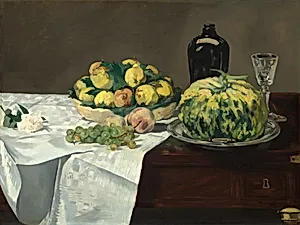
Still Life with Melon and Peaches
c. 1866
Medium
oil on canvas
Dimensions
overall: 68.3 x 91 cm (26 7/8 x 35 13/16 in.) framed: 96.8 x 119.4 x 8.9 cm (38 1/8 x 47 x 3 1/2 in.)
Classification
Painting
Department
CF
Museum
National Gallery of Art, Washington, D.C.
Credit
Gift of Eugene and Agnes E. Meyer
Accession Number
1960.1.1
Rights
Public Domain
Art Historical Context
Edouard Manet's *Still Life with Melon Peaches* (c. 1866) is a vibrant oil-on-canvas painting that captures the simple beauty of ripe fruit—a halved melon and plump peaches—arranged with elegant restraint. Measuring 68.3 x 91 cm, this work exemplifies Manet's mastery of still life, a genre he elevated from academic tradition to modern innovation. As a pivotal figure bridging Realism and Impressionism, Manet infused everyday subjects with bold vitality, using loose, expressive brushstrokes and direct, unfiltered light to create a sense of immediacy and freshness. Painted during a transitional period in French art, when Manet was challenging Salon conventions with his controversial works like *Olympia*, this piece reflects his fascination with texture and color. The juicy translucency of the fruits and subtle shadows showcase his technical prowess, foreshadowing Impressionist techniques later championed by Monet and Renoir. Yet Manet's compositions often flatten space and emphasize surface, prioritizing visual impact over illusionistic depth. Today, housed in the National Gallery of Art as a gift from Eugene and Agnes E. Meyer, this painting invites visitors to appreciate how Manet transformed humble motifs into profound studies of perception and pleasure, influencing generations of artists to celebrate the ordinary with extraordinary flair.
About the Artist
Edouard Manet · 1832–1883
Édouard Manet (1832-1883) was a French painter who played a pivotal role in the transition from Realism to Impressionism, often called the 'Father of Modern Art.' Born into a wealthy Parisian family, Manet defied his father's wishes for a legal career to pursue painting, studying under academic artist Thomas Couture. His revolutionary works 'Le Déjeuner sur l'herbe' and 'Olympia' (both 1863) scand...