
Still Life with Pansies
Medium
Oil on canvas
Dimensions
18 1/2 x 22 1/4 in. (47 x 56.5 cm)
Classification
Paintings
Department
European Paintings
Museum
Metropolitan Museum of Art, New York, NY
Credit
The Mr. and Mrs. Henry Ittleson Jr. Purchase Fund, 1966
Accession Number
66.194
Rights
Public Domain
Tags
Art Historical Context
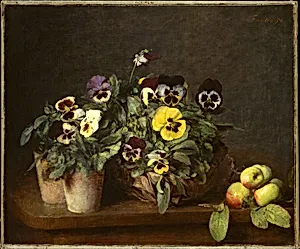
Henri Fantin-Latour's *Still Life with Pansies* (1874) is a exquisite example of 19th-century French still life painting, rendered in oil on canvas measuring 18½ x 22¼ inches. Housed in the Metropolitan Museum of Art's European Paintings department, this work captures the quiet elegance of everyday beauty—vibrant pansies, ripe apples, and delicate flowers arranged with masterful precision. Acquired through The Mr. and Mrs. Henry Ittleson Jr. Purchase Fund in 1966, it invites visitors to savor the tactile richness of its subjects. Fantin-Latour (1836–1904), a prominent Realist painter, elevated the still life genre through his meticulous technique and luminous effects, drawing inspiration from 17th-century Dutch masters like Willem Kalf. In the 1870s, amid the rise of Impressionism, he remained devoted to studio compositions that celebrated nature's transience, rendering petals and fruit with velvety textures and subtle light play that mimic their natural allure. This painting's cultural significance lies in its celebration of humble abundance, reflecting bourgeois tastes of Second Empire France. Notice how the pansies' delicate faces and apples' glossy skins draw the eye, embodying Fantin-Latour's skill in transforming ordinary objects into poetic meditations on time and beauty. A timeless gem for any museum stroll!
About the Artist
Henri Fantin-Latour · 1836–1904
Ignace Henri Jean Théodore Fantin-Latour was born on January 14, 1836, in Grenoble, France, to portrait painter Théodore Fantin-Latour, who gave him his earliest drawing lessons. The family relocated to Paris in 1841, where in 1850, at age 14, he enrolled in the École de Dessin, studying under Horace Lecoq de Boisbaudran, whose innovative memory-based method of drawing from observation profoundly ...