
Stone
Unknown Artist
4th–7th century
Medium
Stone
Dimensions
Overall: 3 3/8 x 1 5/8 x 3/8 in. (8.6 x 4.1 x 0.9 cm)
Classification
Miscellaneous-Stone
Culture
Coptic
Department
Medieval Art
Museum
Metropolitan Museum of Art, New York, NY
Credit
Rogers Fund, 1925
Accession Number
25.10.20.30
Rights
Public Domain
Art Historical Context
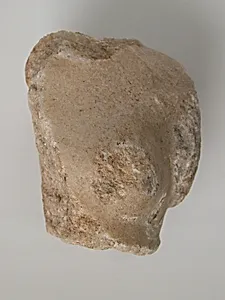
This modest yet evocative stone artifact, simply titled *Stone*, hails from Coptic Egypt during the 4th–7th century—a pivotal era when Christianity flourished in the region following the Roman Empire's adoption of the faith. Crafted from stone and measuring just 3 3/8 x 1 5/8 x 3/8 inches, its small scale suggests it may have been a personal devotional object, architectural fragment, or amulet, common in Coptic material culture. Acquired through the Rogers Fund in 1925, it now resides in the Metropolitan Museum of Art's Department of Medieval Art, highlighting the enduring legacy of early Christian artistry in North Africa. Coptic art, blending Egyptian, Greco-Roman, and Christian influences, often featured stone carvings with symbolic motifs like crosses, animals, or floral patterns, though this piece's specific design remains unrecorded in basic cataloging. Its "Miscellaneous-Stone" classification underscores the diversity of everyday sacred objects produced by Coptic workshops, where stonemasons skillfully incised durable limestone or sandstone to create portable expressions of faith amid a transitioning world. Visitors to the Met will appreciate how such unassuming artifacts reveal the daily spirituality of Coptic communities, bridging pharaonic traditions with emerging Byzantine aesthetics. A testament to resilience, this tiny survivor invites us to ponder the hands that shaped it over 1,500 years ago.