
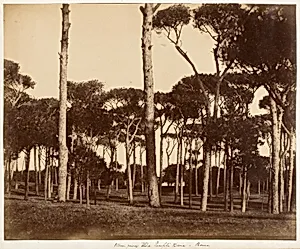
Stone Pines, Villa Pamfili Doria, Rome
Medium
Albumen silver print from paper negative
Dimensions
Image: 20 x 24.8 cm (7 7/8 x 9 3/4 in.)
Classification
Photographs
Department
Photographs
Museum
Metropolitan Museum of Art, New York, NY
Credit
Gilman Collection, Gift of The Howard Gilman Foundation, 2005
Accession Number
2005.100.382 (66)
Rights
Public Domain
Tags
Art Historical Context
In the mid-19th century, as photography emerged as a revolutionary medium, Jane Martha St John captured the timeless beauty of Rome's Villa Pamfili Doria *Stone Pines* (1856). Thisen silver print from a negative depicts the park's iconic stone pines—those majestic umbrella-shaped trees that have defined Roman landscapes for centuries. St John's composition draws the viewer into a serene, dappled light filtering through the branches, evoking the Romantic ideal of nature's grandeur amid historic grounds once belonging to the powerful Doria Pamphili family. The use of a paper negative, akin to the calotype process pioneered by William Henry Fox Talbot, was significant in early photography. It allowed for multiple prints from a single negative, unlike daguerreotypes, and the albumen coating on paper produced sharp, luminous details ideal for landscapes. As one of the few women photographers of her era, St. John's work highlights the medium's democratization, bringing Italy's picturesque vistas to international audiences. Housed in the Metropolitan Museum of Art's Gilman Collection, this 20 x 24.8 cm image stands as a testament to photography's power to preserve fleeting natural scenes with documentary precision and artistic poetry.