
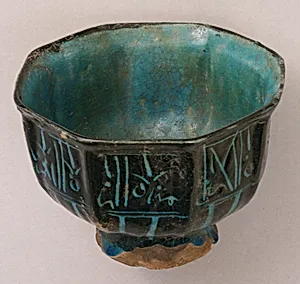
Stonepaste Bowl with Blue and Black Underglaze Painting
Unknown Artist
late 12th century
Medium
Stonepaste; glazed and incised
Dimensions
H. 4 3/4 in. (12.1 cm) Diam. 7 in. (17.8 cm) Wt. 20.4 oz. (578.4 g)
Classification
Ceramics
Department
Islamic Art
Museum
Metropolitan Museum of Art, New York, NY
Credit
H.O. Havemeyer Collection, Gift of Horace Havemeyer, 1945
Accession Number
45.153.4
Rights
Public Domain
Art Historical Context
This elegant stonepaste bowl, crafted in the late 12th, exemplifies the pinnacle of Islamic ceramic artistry from the medieval Islamic world, likely Iran or Syria. Measuring just under 5 inches tall and 7 inches in diameter its sturdy yet refined form—made from a quartz-based stonepaste body—was designed for practical use as tableware while serving as a canvas for sophisticated decoration. The underglaze painting in vibrant blues and stark blacks, combined with incised details, creates dynamic patterns that would have shimmered under candlelight in a wealthy household. Stonepaste, or fritware, was a revolutionary medium developed by Islamic potters around the 10th century to mimic the translucency of coveted Chinese porcelain, unavailable in the West at the time. The technique involved applying pigments beneath a transparent glaze and firing at high temperatures, ensuring durability and luster. Incising—scratching designs into the unfired clay—added texture and depth, highlighting the artisans' mastery of form and surface. Housed in the Metropolitan Museum of Art's Islamic Art Department, this bowl from the H.O. Havemeyer Collection (gifted in 1945) offers a window into the cultural flourishing of the Seljuk era, where ceramics blended utility, beauty, and innovation, bridging everyday life and artistic expression.