
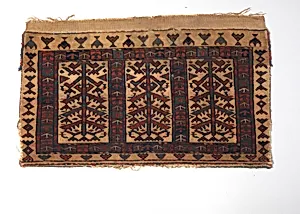
Storage Bag Fragment
Unknown Artist
mid-19th century
Medium
Wool (warp, weft, and pile); symmetrically knotted pile
Dimensions
H. 16 1/4 in.. (41.3 cm) W. 27 1/2 in. (69.9 cm)
Classification
Textiles-Rugs
Department
Islamic Art
Museum
Metropolitan Museum of Art, New York, NY
Credit
Bequest of Joseph V. McMullan, 1973
Accession Number
1974.149.47
Rights
Public Domain
Art Historical Context
This exquisite fragment from a storage bag, dating to the mid-19th century, offers a glimpse into the everyday artistry of Islamic textile traditions. Crafted from wool in warp, weft, and pile, it measures 16¼ by 27½ inches and was likely used by nomadic or rural communities in regions like Anatolia or the Caucasus to store household goods. Such bags were essential for portable lifestyles, blending utility with the same masterful weaving skills seen in grand prayer rugs and carpets. The piece showcases the symmetrically knotted pile technique—also known as the Turkish or Ghiordes knot—where individual knots are mirrored for durability and a plush texture. This method, prevalent in Islamic rug-making, allowed weavers to create dense, resilient fabrics capable of withstanding heavy use. Though incomplete, the fragment highlights the anonymous artisans' expertise in transforming sheep's wool into vibrant, functional art. Housed in the Metropolitan Museum of Art's Islamic Art Department through the bequest of Joseph V. McMullan in 1973, this textile underscores the cultural richness of 19th-century Islamic craftsmanship. It reminds us how even humble objects carried profound aesthetic value, preserving patterns and techniques passed down through generations.