
Stéphane Mallarmé
1891, printed 1919
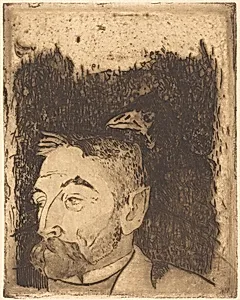
Medium
etching printed in brown on Japan paper
Dimensions
sheet: 33 × 24 cm (13 × 9 7/16 in.) plate: 18.3 × 14.5 cm (7 3/16 × 5 11/16 in.)
Classification
Department
CG-E
Museum
National Gallery of Art, Washington, D.C.
Credit
Rosenwald Collection
Accession Number
1950.16.69
Rights
Public Domain
Art Historical Context
In 1891, Paul Gauguin, the pioneering Post-Impressionist artist known for his bold colors and symbolic imagery, created this intimate etching portrait of Stéphane Mallarmé, the French Symbolist poet. the time, Gauguin was in Paris, immersed in avant-garde circles where literature and art intertwined. Mallarmé, a central figure in the Symbolist movement, embodied the era's fascination with dreams, mystery, and the inner life—ideas that resonated deeply with Gauguin's own evolving style, bridging Impressionism and the exotic visions that would define his later Tahitian works. The artwork is an etching, a meticulous intaglio technique where acid etches fine lines into a metal plate, allowing for rich tonal variations. Printed posthumously in warm brown ink on delicate Japan paper in 1919, it showcases Gauguin's experimental printmaking phase (1889–91), influenced by Japanese ukiyo-e prints. The thin, absorbent Japan paper enhances the subtlety of the ink, lending an ethereal quality to Mallarmé's contemplative gaze. Measuring just 18.3 × 14.5 cm on the plate, its compact scale invites close viewing. Housed in the National Gallery of Art's Rosenwald Collection—a treasure trove of master prints—this piece highlights Gauguin's versatility beyond painting and his ties to Symbolism's cultural vanguard, offering visitors a window into fin-de-siècle Paris's creative ferment.
About the Artist
Paul Gauguin · 1848–1903
Paul Gauguin (1848-1903) was a French Post-Impressionist painter whose bold experiments with color, form, and subject matter made him one of the most influential figures in the transition from 19th-century art to modernism. His rejection of European civilization for the perceived authenticity of 'primitive' cultures established an archetype of artistic exile that continues to resonate. Gauguin's ...