
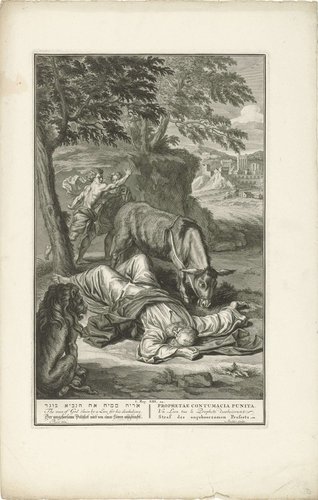
Straf van de ongehoorzame godsman
1720 - 1728
Medium
engraving
Dimensions
222; 353
Rights
Public Domain
About this artwork
opschrift, verso, handgeschreven: ‘Utrechts Fundatie Huijs’
Art Historical Context
This engraving by Joseph Mulder, created between 1720 and 1728, captures a dramatic biblical scene titled *Straf van de ongehoorzame godsman* (Punishment of the Disobedient Man of God). The work measures 353 by 222 millimeters and exemplifies the refined technique of Dutch engraving during the early eighteenth century. prints were widely valued for their ability to reproduce intricate details and moral narratives, making religious stories accessible beyond elite circles. Mulder, working in the tradition of Dutch printmaking, likely drew on established iconography to depict the consequences of disobedience as described in scripture. Engravings like this one played a vital cultural role, often serving as book illustrations or standalone devotional objects that encouraged reflection on faith and obedience. The handwritten inscription on the verso, noting “Utrechts Fundatie Huijs,” suggests the print once belonged to an institutional collection in Utrecht, highlighting its journey through Dutch cultural heritage. Today, the piece offers viewers a glimpse into the moral and artistic priorities of its era, where technical precision met spiritual storytelling. Its survival in museum collections underscores the enduring appeal of such works as both artistic achievements and historical documents.
About the Artist
Joseph Mulder · 1659–1718
Joseph Mulder (1659/1660–1710 or later) was a renowned Dutch Golden Age printmaker whose work exemplifies the sophisticated reproductive engraving practiced in Amsterdam during the late seventeenth and early eighteenth centuries. Trained under notable masters including Bogaert and influenced by Romeyn de Hooghe, Mulder achieved particular distinction for his scientific illustrations, most notably ...