
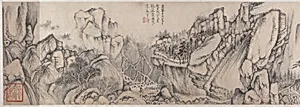
明 趙左 谿山無盡圖 卷|Streams and Mountains without End
dated 1611–12
Medium
Handscroll; ink and color on paper
Dimensions
Image: 9 5/8 x 248 5/8 in. (24.4 x 631.5 cm) Overall with mounting: 11 3/4 x 465 3/4 in. (29.8 x 1183 cm)
Classification
Paintings
Culture & Period
China · Ming dynasty (1368–1644)
Department
Asian Art
Museum
Metropolitan Museum of Art, New York, NY
Credit
Purchase, The Dillon Fund Gift, 1976
Accession Number
1976.219
Rights
Public Domain
Tags
Art Historical Context
Created during China’s Ming dynasty (1368–1644), Zhao Zuo’s handscroll *Streams and Mountains without End* captures the timeless Chinese fascination with landscape as a vehicle for contemplation. Painted in ink and color on paper and dated 1611–12, the work stretches more than twenty feet long, inviting viewers to “travel” through its scenery as the scroll is gradually unrolled from right to left. This intimate, sequential viewing experience distinguishes the handscroll format and encourages a meditative engagement with nature’s rhythms. The painting’s title and dominant mountain motifs reflect a long-standing literati tradition in which towering peaks, winding streams, and misty valleys symbolize both the grandeur of the natural world and the artist’s inner spirit. Zhao Zuo’s delicate layering of ink washes and subtle touches of color guide the eye across successive scenes, creating a sense of endless recession and renewal. Such compositions were prized by Ming collectors for their ability to evoke Daoist ideas of harmony between humanity and the cosmos within the quiet space of a scholar’s studio.
About the Artist
Zhao Zuo · 1560–1630
**Zhao Zuo** (Chinese: 赵左; c. 1570–after 1633) was a noted Ming dynasty painter from Huating (present-day Songjiang, Shanghai). His style name was Wendu. He specialized in literati-style landscapes executed with a rich yet pure brushstroke technique. Zhao followed the painter Song Xu and became one of the leading representatives of the Su Song Style (苏松派), a regional school of landscape painting ...