
Strength
Medium
Engraving
Dimensions
Sheet (trimmed): 2 15/16 × 2 3/16 in. (7.5 × 5.5 cm)
Classification
Prints
Department
Drawings and Prints
Museum
Metropolitan Museum of Art, New York, NY
Credit
Harris Brisbane Dick Fund, 1917
Accession Number
17.3.1380
Rights
Public Domain
Tags
Art Historical Context
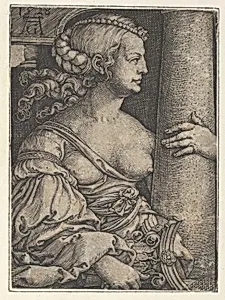
Heinrich Aldegrever's *Strength* (1528) is a exquisite example of Northern Renaissance engraving, crafted by one of the renowned "Little Masters." This German artist and goldsmith, active in Soest, Westphalia, specialized in intricate small-scale prints that rivaled the finesse of larger works by masters like Albrecht Dürer. Measuring just under 3 by 2 inches, this trimmed sheet exemplifies the precision of copperplate engraving, where fine lines and cross-hatching create depth, texture, and luminous highlights on a nude female figure in profile—likely personifying the virtue of Fortitudo. The artwork's subject draws from classical and Christian iconography, portraying Strength as a poised, muscular woman, evoking both physical power and moral fortitude. Such allegorical nudes were popular in 16th-century prints, blending humanist ideals with Renaissance revival of antiquity. Aldegrever's technique shines in the delicate rendering of anatomy, hair, and drapery, making this intimate piece ideal for collectors' albums or scholarly study. Acquired through the Harris Brisbane Dick Fund for the Metropolitan Museum of Art's Drawings and Prints department, *Strength* highlights the era's booming print market, which democratized art ownership across Europe. Visitors will appreciate its timeless celebration of resilience in a format that rewards close inspection.
About the Artist
Heinrich Aldegrever · 1502–1561
Heinrich Aldegrever, born in 1502 in Paderborn, Westphalia, to parents Herman and Katherine Trippenmeker—a family of clog-makers known by the dialect name Trippenmecker—emerged as a multifaceted artist in the German Renaissance. His early training remains undocumented, though he likely apprenticed in a Soest goldsmith's workshop after relocating there around 1525, where he joined the painters' gui...