
Strip
Unknown Artist
early 18th century
Medium
Bobbin lace
Dimensions
L. 44 x W. 3 inches (111.8 x 7.6 cm)
Classification
Textiles-Laces
Culture
Flemish, Brussels
Department
European Sculpture and Decorative Arts
Museum
Metropolitan Museum of Art, New York, NY
Credit
Purchase by subscription, 1909
Accession Number
09.68.206
Rights
Public Domain
Art Historical Context
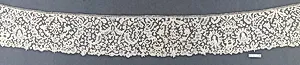
This exquisite bobbin lace strip, crafted in early 18th-century Brussels, exemplifies the pinnacle of Flemish lace-making artistry. Measuring 44 inches long by 3 wide, this delicate textile was created using the intricate bobbin lace technique, fine threads are twisted and plaited on a pillow with pins to form elaborate patterns. Produced in Brussels—a renowned center for lace production during the Baroque era—this piece likely served as a decorative border for garments, furnishings, or ecclesiastical vestments, showcasing the era's opulent craftsmanship. Bobbin lace from Flanders, particularly Brussels, reached its height of technical sophistication in the 17th and 18th centuries, rivaling painting in its precision and complexity. Flemish lacemakers developed styles like "Brussels ground," featuring a mesh of hexagonal motifs filled with floral or scrolling designs, demanding immense skill and patience. Acquired by the Metropolitan Museum of Art in 1909 through public subscription, this anonymous work highlights the collaborative genius of guild-trained artisans, whose innovations influenced European fashion and decorative arts. As a preserved artifact in the Met's European Sculpture and Decorative Arts collection, the *Strip* invites us to marvel at the unseen labor behind luxury textiles—threads finer than hair woven into timeless elegance, symbols of wealth and cultural refinement in an age of absolutist courts.