
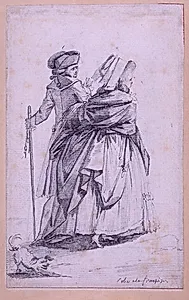
Strolling Couple with a Dog
Medium
Graphite on faded green laid paper
Dimensions
169 x 107 mm
Classification
Drawings
Culture
French
Department
Robert Lehman Collection
Museum
Metropolitan Museum of Art, New York, NY
Credit
Robert Lehman Collection, 1975
Accession Number
1975.1.675
Rights
Public Domain
Tags
About this artwork
Gandolphe Jean Emile Francis Moutier's "Strolling Couple with a Dog" (circa 1820) captures early 19th-century French bourgeois leisure with economical yet evocative draftsmanship. Executed in graphite on faded green laid paper (169 x 107 mm), this intimate drawing depicts a fashionably dressed couple taking their daily promenade, accompanied by a small dog—activities central to Restoration and July Monarchy social life. The work exemplifies the period's taste for genre scenes documenting contemp...
Art Historical Context
In the early 19th century, France's Restoration and July Monarchy eras, the leisurely promenade was a hallmark of bourgeois social life. Gandolphe Jean Emile Moutier's *Strolling Couple with a* (ca. 1820) charmingly captures this moment: a fashionably dressed couples arm-in-arm with their petite canine companion. This intimate graphite drawing on faded green laid paper ( x 107 mm) the period's fascination with genre scenes—everyday vignettes of manners, costumes, and relationships—echoing masters like Louis-Léopold Boilly and Jean-Louis-Ernest Meissonier. Moutier (1793–1854), active in a transitional age bridging Neoclassicism's precision with emerging Romanticism and Realism, employs economical draftsmanship: crisp lines delineate social status and fashion details, while subtle shading suggests atmosphere and intimacy. The green toned paper, prized for its aesthetic warmth, enabled tonal depth through graphite shadows and potential white heightening, mimicking painted effects on a modest scale. Its faded state today offers a window into 19th-century materials and techniques. Housed in the Metropolitan Museum of Art's Robert Lehman Collection since 1975, this unassuming gem exemplifies Lehman's passion for high-quality European drawings by both famous and overlooked artists. It preserves vivid snapshots of past customs, inviting us to stroll alongside this elegant trio.