
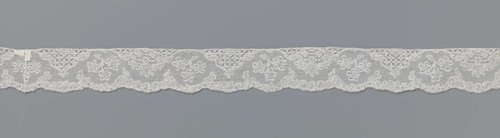
Strook kloskant met berg en dal-lijn
c. 1740
Medium
bobbin lace
Dimensions
253; 9.5; 300; 5
Rights
Public Domain
About this artwork
lengte 300 cm (Totale lengte van de twee aan elkaar genaaide stroken BK-BR-J-136 en BK-BR-J-140.) x lengte 253 cm (Lengte van de strook BK-BR-J-136.) x breedte 5 cm x rapportlengte 9,5 cm
Art Historical Context
Welcome to our exhibit on 18th-century lace artistry *Strook kloskant berg en dal-lijn (Strip Bobbin Lace with Mountain and Valley), created around 1740 by an anonymous artisan, showcases the exquisite precision of bobbin lace from the Low Countries. This strip measures an impressive total length of cm—formed by stitching together two pieces (one 253 cm long)—with a narrow width of just 5 cm and a repeating pattern every 9.5 cm. The "berg en dal-lijn" refers to its distinctive zigzag motif, evoking undulating mountains and valleys, a playful geometric design typical of Flemish and Dutch lace traditions. Bobbin lace, or *kloskant*, emerged as a virtuoso craft in the 16th century and peaked in the 18th, when it adorned elite garments, altar cloths, and furnishings as a symbol of wealth and refinement. Artisans used wooden bobbins to intertwine fine linen threads over a pricked paper pattern, creating intricate, durable lace without needles. This anonymous work highlights the skilled, often female-led workshops of the era, where such long strips were prized for borders on sleeves, collars, or table linens. Though unattributed, its survival speaks to the cultural reverence for lace in Rococo-era Europe, blending utility with ornamental beauty. Imagine the hours of patient twisting that brought this rhythmic pattern to life—a testament to craftsmanship that turned thread into treasure!
About the Artist
anonymous
In the vast tapestry of art history, "Anonymous" stands not as a singular individual but as a collective designation for countless unidentified creators whose works have endured across millennia. These artists, spanning prehistoric cave painters to medieval illuminators and folk craftsmen, produced the foundational layers of human visual culture. Prior to the Renaissance, when individual fame emer...