
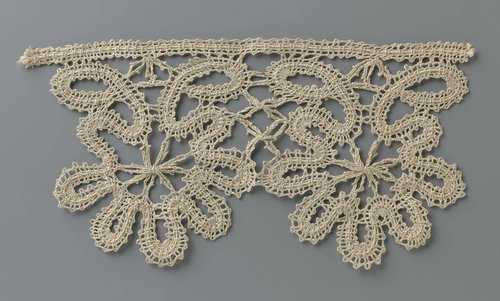
Strook kloskant met twee schulpen elk gevormd door een zevenlobbige bloem tussen twee ovale bladeren gemaakt met een geklost lint
c. 1925 - c. 1932
Medium
bobbin lace
Dimensions
13.5; 13; 27
Rights
Public Domain
About this artwork
kloskant, vlechtengrond
Art Historical Context
This delicate strip of bobbin lace, created anonymously around 1925–1932, showcases the intricate artistry of traditional Flemish-Dutch lace-making. Measuring 27 cm long by 13.5 cm wide, it features two elegant shell motifs, each crafted from a seven-lobed flower nestled between two oval leaves. The design is executed with a plaited ribbon technique on a vlechtengrond, or plaited ground, where threads are woven into a sturdy, textured foundation that highlights the organic floral forms. Bobbin lace, or *kloskant*, originated the 16th century in Europe, particularly in regions like Flanders and Brabant, where it became a coveted craft symbolizing patience and skill. By the interwar period, this piece reflects a revival of handmade lace amid industrialization, often produced by skilled women in home workshops for fashion, furnishings, or as gifts. The plaiting method—using multiple bobbins to twist and interlace fine threads—creates a durable yet finely detailed fabric, blending geometric precision with naturalistic motifs inspired by nature. As a snapshot of early 20th-century craftsmanship, this anonymous work underscores lace's cultural role in European domestic arts, bridging Renaissance traditions with Art Deco-era aesthetics. Visitors will appreciate its tactile beauty, a testament to the enduring allure of handwoven heritage.
About the Artist
anonymous
In the vast tapestry of art history, "Anonymous" stands not as a singular individual but as a collective designation for countless unidentified creators whose works have endured across millennia. These artists, spanning prehistoric cave painters to medieval illuminators and folk craftsmen, produced the foundational layers of human visual culture. Prior to the Renaissance, when individual fame emer...