
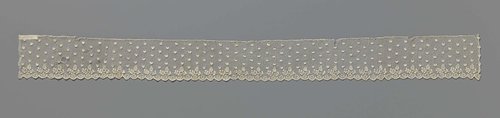
Strook naaldkant met hartjes
ca. 1790 - ca. 1799
Medium
Alençon lace
Dimensions
2.4; 6.5; 69
Rights
Public Domain
About this artwork
naaldkant, grond met fijne enkelvoudige mazen ontstaan uit één (soms gedraaide) festonsteek
Art Historical Context
Welcome to our exhibit featuring *Strook naaldkant met hartjes* (Strip of Needle Lace with Hearts an exquisite anonymous example of Alençon lace from around 1790–1799. This delicate strip, measuring 69 cm long and just 6.5 cm wide, was likely designed as a trimming for garments like cuffs, collars, or dress edges—hallmarks of late 18th-century European fashion. Crafted during the turbulent era of the French Revolution, reflects the enduring luxury of lace-making traditions amid social upheaval. Alençon lace, originating from the Normandy town of Alençon, is renowned for its needlepoint technique (*naaldkant*), where every thread is meticulously stitched by hand without a supporting fabric. The ground features fine, single meshes formed from a single (sometimes twisted) festoon stitch, creating a lightweight, translucent honeycomb effect. Playful heart motifs add a romantic flourish, showcasing the artisan's precision and whimsy in this labor-intensive medium. As a symbol of refined craftsmanship, Alençon lace held royal prestige in France, protected by guild monopolies until the Revolution. This piece highlights how such opulent textiles persisted as status symbols, bridging pre- and post-revolutionary tastes. A testament to anonymous skill, it invites us to appreciate the hidden artistry in everyday elegance.
About the Artist
anonymous
In the vast tapestry of art history, "Anonymous" stands not as a singular individual but as a collective designation for countless unidentified creators whose works have endured across millennia. These artists, spanning prehistoric cave painters to medieval illuminators and folk craftsmen, produced the foundational layers of human visual culture. Prior to the Renaissance, when individual fame emer...