
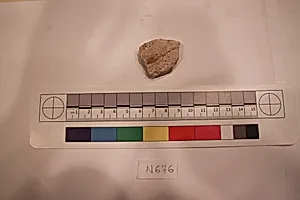
Stucco Fragment
Unknown Artist
probably 8th–12th century
Medium
Stucco; carved
Dimensions
H. 1 3/16 in. (3 cm) W. 1 3/16 in. (3 cm) D. 3/8 in. (1 cm)
Classification
Stucco
Department
Islamic Art
Museum
Metropolitan Museum of Art, New York, NY
Credit
Rogers Fund, 1948
Accession Number
48.101.978
Rights
Public Domain
Art Historical Context
This delicate **Stucco Fragment**, likely created between the 8th and 12th centuries, invites us into the world of early Islamic. Acquired through the Rogers Fund in 1948 and now housed in the Metropolitan Museum Art's Islamic Art department, this tiny carved piece—measuring just 1 3/16 inches and 3/8 inch deep—survives as a testament to the ingenuity of anonymous artisans from regions like Iran, Iraq, or Central Asia during the Abbasid or Seljuk periods. Stucco, a versatile plaster medium, was a hallmark of Islamic decorative arts, prized for its lightweight quality and ability to mimic more precious stone carving. Artisans molded and incised it by hand to adorn mosques, palaces, and mihrabs (prayer niches), creating textured surfaces that caught the play of light in sunlit interiors. Though worn by time, this fragment hints at the precision required for such work, reflecting a cultural emphasis on beauty in everyday sacred spaces. Its small scale underscores how even modest fragments preserve grand histories, offering modern visitors a tangible link to a era of cultural flourishing where art served both spiritual and aesthetic purposes. A quiet marvel amid larger treasures!