
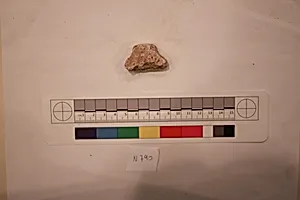
Stucco Fragment
Unknown Artist
probably 8th–12th century
Medium
Stucco; carved
Dimensions
H. 1 9/16 in. (4 cm) W. 13/16 in. (2 cm) D. 9/16 in. (1.5 cm)
Classification
Stucco
Department
Islamic Art
Museum
Metropolitan Museum of Art, New York, NY
Credit
Rogers Fund, 1948
Accession Number
48.101.1092
Rights
Public Domain
Art Historical Context
This delicate stucco fragment, carved by an unknown artist around the 8th–12th century, offers a glimpse into the refined world of Islamic architecture. Measuring just 1 9/16 inches high, 13/16 inches wide, 9/16 inches, it is a tiny survivor from a larger decorative ensemble, likely adorning a mosque, palace or tomb. Stucco, a molded plaster made from gypsum or lime, was prized in the Islamic world for its versatility—lightweight yet durable, it allowed artisans to create intricate carvings that transformed plain surfaces into shimmering displays of artistry. In the Islamic artistic tradition of this era, spanning the Abbasid and Fatimid periods, stucco fragments like this exemplify masterful low-relief techniques. Craftsmen incised motifs such as geometric patterns, floral arabesques, or calligraphy, evoking spiritual harmony and infinite beauty without figurative representation. Though worn by time, such pieces highlight the era's emphasis on abstraction and mathematical precision, influencing architecture from Iran to Spain. Acquired through the Rogers Fund in 1948, this fragment now in the Metropolitan Museum of Art's Department of Islamic Art. Its modest size belies its cultural weight, reminding us how everyday materials became vehicles for profound aesthetic and religious expression in medieval Islamic societies.