
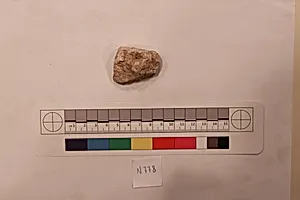
Stucco Fragment
Unknown Artist
probably 8th–12th century
Medium
Stucco; carved
Dimensions
H. 1 9/16 in. (4 cm) W. 1 3/16 in. (3 cm) D. 1 in. (2.5 cm)
Classification
Stucco
Department
Islamic Art
Museum
Metropolitan Museum of Art, New York, NY
Credit
Rogers Fund, 1948
Accession Number
48.101.1080
Rights
Public Domain
Art Historical Context
This delicate stucco fragment, likely from the 8th–12th century, offers a glimpse into the refined decorative arts of the medieval Islamic world. Housed in the Metropolitan Museum of Art's Department Islamic Art and acquired through the Rogers Fund in 1948, it measures just a few centimeters—standing at 1 9/16 inches high, 1 3/16 inches wide, and1 inch deep—highlight the extraordinary precision of ancient craftsmen working on a miniature scale. Carved from stucco, a versatile plaster-like material made from gypsum or lime, this fragment exemplifies a technique widely used across regions like Iraq, Iran, Egypt, and North Africa during the Abbasid and Fatimid periods. Artisans molded wet stucco into panels or architectural elements, then incised intricate patterns—often geometric motifs, arabesques, or floral designs—before it hardened. These decorations adorned mosques, palaces, and tombs, transforming plain surfaces into shimmering displays of mathematical harmony and natural inspiration, central to Islamic aniconic aesthetics. Though its exact provenance remains unknown, such fragments preserve the ephemeral beauty of Islamic architecture, where stucco served as an affordable yet elegant alternative to stone carving. This tiny survivor invites us to imagine vast, ornate interiors alive with light and shadow.