
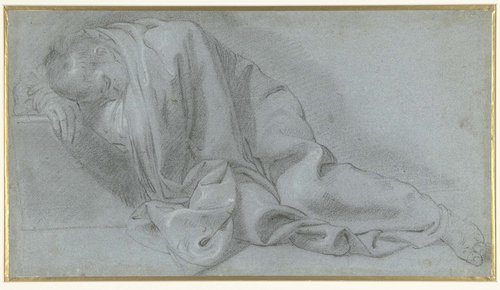
Studie van een op de grond ingeslapen mannelijk model
1587 - 1660
Medium
paper
Dimensions
400; 225
Rights
Public Domain
About this artwork
hoogte 225 mm x breedte 400 mm
Art Historical Context
Giacomo Cavedone’s “Studie van een op de grond ingeslapen mannelijk model” offers a quietly powerful glimpse into the artist’s working process. Created on paper measuring 225 by 400 millimeters, the drawing captures a male figure in a completely relaxed, unposed state, lying on the ground as though overcome by sleep. Cavedone, active in early seventeenth-century Bologna, belonged to the generation of artists who prized direct observation of the human body, moving away from idealized studio formulas toward more natural, lifelike studies. Such drawings were essential tools for Baroque painters. They allowed artists to explore anatomy, foreshortening, and the play of light and shadow on real flesh before committing ideas to canvas. The informal pose here—unguarded and slightly awkward—reflects the period’s growing interest in everyday human experience, an approach championed by the Carracci academy in Bologna where Cavedone trained. Though modest in scale and medium, the sheet reveals Cavedone’s sensitivity to the quiet dignity of the human form at rest. Visitors can appreciate how even a simple study on paper contributed to the emotional immediacy that defines much of Baroque art.
About the Artist
Giacomo Cavedone · 1577–1660
Italian, Sassuolo 1577–1660 Bologna