
Studies of a Male Nude
1912
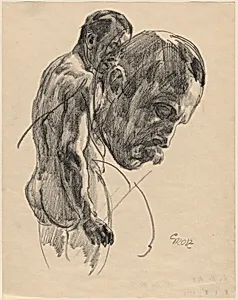
Medium
black conte crayon on Japan paper
Dimensions
sheet: 29 × 23 cm (11 7/16 × 9 1/16 in.)
Classification
Drawing
Department
CG-W
Museum
National Gallery of Art, Washington, D.C.
Credit
Ailsa Mellon Bruce Fund
Accession Number
2013.85.1
Rights
Public Domain
Art Historical Context
**Studies of a Male Nude by George Grosz, in 1912, offers a glimpse into the young artist's early mastery of the human form. At just 19, Grosz—a German draughtsman later famed for his biting Dadaist and New Objectivity satires of Weimar society—was honing his skills at Berlin's Royal Academy of Arts. drawing, executed in black conté crayon on delicate Japan paper (sheet: 29 × 23 cm), reflects the academic tradition of nude studies, essential for training in anatomy and proportion during the pre-World War I era. The conté crayon's rich, velvety texture allows for bold contours and subtle tonal modeling, ideal for capturing the male figure's musculature on the smooth, thin Japan paper, which resists smudging and enhances fine details. These studies showcase Grosz's emerging Expressionist influences, with dynamic poses emphasizing movement and volume—foreshadowing his later provocative urban scenes. Acquired through the Ailsa Mellon Bruce Fund and housed in the National Gallery of Art's Prints and Drawings department (CG-W), this work highlights Grosz's technical foundation before his shift to social critique. A testament to timeless artistic practice, it invites visitors to appreciate the disciplined beauty beneath his future iconoclasm.
About the Artist
George Grosz · 1893–1959
George Grosz (1893–1959) was a German-American artist whose savage satirical drawings and paintings became some of the most powerful visual critiques of militarism, capitalism, and social decay in twentieth-century art. Born Georg Ehrenfried Gross in Berlin, he studied at the Dresden Academy of Fine Arts and the Berlin School of Arts and Crafts before serving in World War I, an experience that rad...