
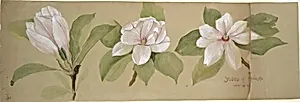
Studies of Magnolias
1891
Medium
Graphite, watercolor, and ink on brown wove paper
Dimensions
Overall: 6 13/16 x 20 1/8 in. (17.3 x 51.1 cm) Design: 6 13/16 x 18 13/16 in. (17.3 x 47.8 cm) Matted: 16 x 22 in. (40.6 x 55.9 cm)
Classification
Drawing
Culture
American
Department
The American Wing
Museum
Metropolitan Museum of Art, New York, NY
Credit
Gift of Tiffany & Co., 1985
Accession Number
1985.1101.3
Rights
Public Domain
Tags
Art Historical Context
Nestled in The Metropolitan Museum of Art's American Wing, *Studies of Magnolias* (1891) by Tiffany & Co. offers a delicate glimpse into the design workshops of one of America's premier luxury firms. Created with graphite, watercolor, and ink on brown wove paper, this preparatory sheet measures about 6 13/16 x 20 1/8 inches and captures multiple views of magnolia flowers and leaves in intricate detail. Donated by Tiffany & Co. itself in 1985, it highlights the company's mastery of nature-inspired motifs during the Gilded Age. These studies exemplify the meticulous process behind Tiffany's renowned jewelry, silverware, and decorative objects. Magnolias, with their lush petals and bold leaves, were popular symbols of elegance and American identity, often translated into opulent designs. The mixed-media technique—precise graphite outlines, subtle watercolor washes, and fluid ink accents—allowed designers to experiment with form, texture, and composition on affordable brown wove paper before committing to final pieces. As a rare surviving artifact from Tiffany's archives, this work underscores the firm's artistic innovation, bridging fine art and craftsmanship in late 19th-century America. Visitors will appreciate how such sketches fueled the enduring beauty of Tiffany's creations.
About the Artist
Tiffany & Co. · 1837–present
Tiffany & Co., founded on September 18, 1837, by Charles Lewis Tiffany and John B. Young in New York City as a stationery and fancy goods store, quickly evolved into a premier American house for jewelry and decorative arts. Under Charles's leadership, the firm introduced innovations like the sterling silver standard in 1851 and the iconic six-prong Tiffany Setting engagement ring in 1886, establis...