
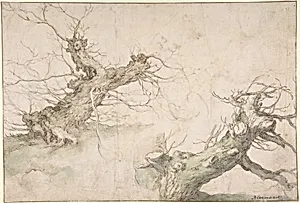
Studies of Two Pollard Willows; Verso: Wide Landscape Prospect
late 16th–mid-17th century
Medium
Pen and brown ink, watercolor, traces of black chalk, framing line in pen and brown ink; verso black chalk and watercolor
Dimensions
8 1/4 x 12 3/16 in. (21 x 31 cm)
Classification
Drawings
Department
Drawings and Prints
Museum
Metropolitan Museum of Art, New York, NY
Credit
Rogers Fund, 1970
Accession Number
1970.242.3
Rights
Public Domain
Tags
Art Historical Context
Abraham Bloemaert, a Dutch artist of the late 16 to mid-17th century, captures the rugged beauty of nature in this exquisite double-sided drawing. On the recto, meticulous studies of two pollardows—trees deliberately pruned to sprout dense, knobby crowns—reveal Bloemaert's keen observation of form and texture. Created during the transition from Mannerism to the Dutch Golden Age, these sketches exemplify his role in Utrecht's vibrant artistic circle, where landscape studies bridged scientific naturalism and poetic expression. Rendered in pen and brown ink with watercolor washes and subtle black chalk underdrawing, the work showcases Bloemaert's masterful technique for conveying light, volume, and atmospheric depth on a modest 8¼ x 12⅜-inch sheet. The verso features a sweeping landscape prospect in black chalk and watercolor, hinting at panoramic views that influenced his oil paintings and etchings. Such versatile drawings were prized by collectors for their spontaneity and as models for students. Acquired through the Rogers Fund in 1970, this gem from The Metropolitan Museum of Art's Drawings and Prints collection highlights Bloemaert's enduring legacy in elevating everyday trees into symbols of resilience and the Dutch countryside's timeless allure.
About the Artist
Abraham Bloemaert · 1566–1651
Abraham Bloemaert (1566–1651) was born in Gorinchem in the Dutch Republic, the son of architect Cornelis Bloemaert, and grew up in Utrecht after the family relocated there in 1575. His early artistic formation took him to Paris for three years in the early 1580s, where he studied with several masters before returning to the Northern Netherlands to pursue his career. He settled permanently in Utrec...