
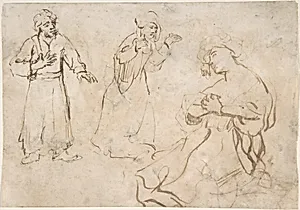
Study for a Pieta
Medium
Pen and brown ink
Dimensions
sheet: 4 3/4 x 6 11/16 in. (12.1 x 17 cm)
Classification
Drawings
Department
Drawings and Prints
Museum
Metropolitan Museum of Art, New York, NY
Credit
Gift of W. R. Valentiner, 1910
Accession Number
10.1
Rights
Public Domain
Tags
Art Historical Context
Rembrandt van Rijn, the eminent Dutch artist of the Baroque era (1606–1669), created this intimate *Study for a Pietà* using pen and brown ink on modest sheet measuring just 4 3/4 x 6 11/16 inches. The Pietà motif—depicting the Virgin Mary cradling the dead Christ, often with attendant figures—has deep roots Christian iconography, ev profound sorrow and maternal grief. Rembrandt's rendition, tagged with figures of men and women, this timeless theme through his signature emotional intensity, likely as a preparatory sketch for a larger painting or etching. Rendered in fluid pen strokes, the drawing exemplifies Rembrandt's mastery of line and gesture during the Dutch Golden Age. Brown ink allowed for rich tonal variations, hinting at the chiaroscuro effects that defined his paintings. These studies were central to his process, enabling rapid exploration of composition, anatomy, and expression before committing to canvas. Though undated precisely, it reflects his lifelong fascination with biblical narratives and human pathos. Today, housed in the Metropolitan Museum of Art's Drawings and Prints department (gift of W. R. Valentiner, 1910), this work invites visitors to appreciate Rembrandt's genius in miniature form—where every line conveys quiet drama and spiritual depth.
About the Artist
Rembrandt (Rembrandt van Rijn) · 1606–1669
Rembrandt Harmenszoon van Rijn (1606–1669) stands as one of the greatest visual artists in the history of Western art and the most important Dutch painter of the 17th century. Born in Leiden to a prosperous miller's family, Rembrandt transformed painting through his revolutionary use of light and shadow, his psychological depth in portraiture, and his elevation of etching to a fine art. His approx...