
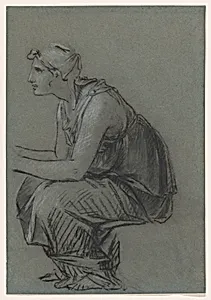
Study for Astyanax’s Nurse
ca. 1812
Medium
Black and white chalk, with stumping, on blue paper
Dimensions
Sheet: 11 5/16 × 7 13/16 in. (28.8 × 19.9 cm)
Classification
Drawings
Department
Drawings and Prints
Museum
Metropolitan Museum of Art, New York, NY
Credit
Gift of Louis de Bayser, 2015
Accession Number
2015.652.1
Rights
Public Domain
Tags
Art Historical Context
Pierre-Paul Prud'hon, a leading French artist of the Napoleonic era (17581823), created this delicate *Study for Astyanax’s Nurse* around1812. Bridging Neoclassicism emerging Romanticism, Prud'h was renowned for his elegant, lit figures drawn from mythology and history. Here, the profile of a woman—likely the Trojan nurse of Hector's infant Astyanax from Virgil's *Aeneid*—evokes quiet pathos amid the Trojan War's tragedy, where Astyanax meets a grim fate. This preparatory drawing captures Prud'hon's process for larger compositions, emphasizing emotional depth over strict classical ideals. Executed in black and white chalk with stumping on blue paper, the work exemplifies 19th-century draftsmanship techniques. Stumping—a method of blending chalk with a soft tool—produces velvety transitions of light and shadow, enhancing the figure's contemplative expression and drapery folds. The tinted blue paper adds a luminous, atmospheric glow, a favored ground for chiaroscuro effects in figure studies, allowing Prud'hon to model form with exquisite sensitivity. Housed in the Metropolitan Museum of Art's Drawings and Prints department (gift of Louis de Bayser, 2015), this 11 5/16 × 7 13/16 in. sheet highlights Prud'hon's mastery of the profile pose, a nod to antique cameos and Renaissance precedents. It invites visitors to appreciate the intimate artistry behind grand narratives, revealing how such studies brought ancient myths to life with tender humanity.
About the Artist
Pierre Paul Prud'hon · 1758–1823
Pierre Paul Prud'hon (1758–1823) was a French painter and draughtsman whose dreamy, sensuous art occupied a singular position between the Neoclassicism and Romanticism that competed for dominance in French painting around 1800. Born in Cluny in Burgundy, he received his early artistic training at the Dijon Academy before winning the Prix de Rome of the Estates of Burgundy, which allowed him to spe...