
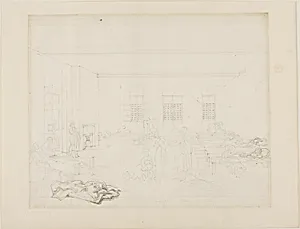
Study for Bridewell Prison, Women's Side, from Microcosm of London
c. 1808
Medium
Graphite on ivory wove paper
Dimensions
21 × 26.1 cm (8 5/16 × 10 5/16 in.)
Classification
graphite
Department
Prints and Drawings
Museum
Art Institute of Chicago
Accession Number
113128
Rights
Public Domain
Art Historical Context
Augustus Charles Pugin's *Study for Bridewell Prison Women's Side, from Micro of London* (c. 1808) offers a poignant glimpse into early 19th-century London life. Created as a preparatory drawing for Rudolph Ackermann's celebrated publication *Microcosm of London*1808–10), this graphite sketch on ivory wove paper captures the stark interior of Bridewell Prison's women's ward. Pugin, a master of architectural draughtsmanship known for his precise, topographical style, meticulously rendered the prison's utilitarian architecture—high barred windows, rows of beds, and sparse furnishings—to evoke the harsh realities of incarceration for petty offenders, often vagrant women and prostitutes. The *Microcosm* series, illustrated by Pugin alongside Thomas Rowlandson, brought London's public institutions to life through detailed vignettes, blending factual accuracy with subtle social commentary. This 21 × 26.1 cm study exemplifies Pugin's technique: fine graphite lines on smooth ivory paper allowed for intricate shading and texture, essential for translating into the book's vibrant aquatint engravings. Bridewell, originally a royal palace turned prison in 1553, symbolized Georgian-era reform efforts amid rising urban poverty. Housed in the Art Institute of Chicago's Prints and Drawings Department, this work highlights Pugin's influence on picturesque illustration and urban documentation, inviting viewers to reflect on the era's social divides.
About the Artist
Augustus Charles Pugin · 1762–1832
Augustus Charles Pugin (1762–1832) was a pioneering architectural draughtsman and engraver whose meticulous illustrations played a pivotal role in reviving interest in Britain's medieval Gothic heritage. Born in France, Pugin relocated to London around 1792, where he quickly established himself as a master of topographical and architectural rendering. Working primarily in engraving and watercolor,...