
Study for "Le Cygne" (Swan)
c. 1904
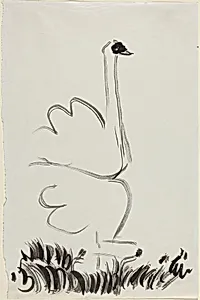
Medium
brush and black ink
Dimensions
overall: 30.9 x 19.9 cm (12 3/16 x 7 13/16 in.)
Classification
Drawing
Department
CG-E
Museum
National Gallery of Art, Washington, D.C.
Credit
Virginia and Ira Jackson Collection
Accession Number
2001.136.41
Rights
Public Domain
Art Historical Context
Pierre Bonnard's *Study for "Le Cne" (Swan)*, created around 1904, invites visitors into the intimate preparatory world of this French Post-Impressionist. Bonnard, a leading member of the Nabi group alongside peers like Maurice Denis and Édouard Vuillard, blended symbolism with everyday observation, often capturing domestic scenes bathed in soft light. This modest drawing, measuring just 30.9 x 19.9 cm, served as a sketch for his painting *Le Cygne*, his thoughtful planning process during a pivotal period when he transitioned toward more vibrant, color-saturated canvases. Rendered in brush and black ink, the work highlights Bonnard's fluid, expressive linework—a technique that allowed for spontaneity and subtle modeling without the permanence of paint. The brush's versatility produced dynamic strokes, evoking the grace of the swan motif while hinting at broader themes of nature and serenity in his oeuvre. Housed in the National Gallery of Art's CG-E Department as part of the Virginia and Ira Jackson Collection, this classified drawing reveals the artist's meticulous groundwork, bridging his graphic roots and painterly innovations. A charming glimpse into early 20th-century studio practice, it reminds us how Bonnard's sketches fueled his lifelong pursuit of joy in the ordinary.
About the Artist
Pierre Bonnard · 1867–1947
Pierre Bonnard (1867–1947) was a French painter and printmaker who became a leading figure in the Post-Impressionist movement and a founding member of Les Nabis. Born on October 3, 1867, in Fontenay-aux-Roses, France, Bonnard initially studied law at his father's insistence, graduating and briefly practicing as a barrister in 1888. However, his true passion lay in art, and he had simultaneously at...