
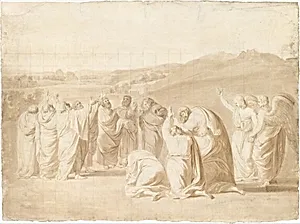
Study for "The Ascension"
Medium
Ink ("Bistre") washes, pen and ink, black chalk, and graphite on off-white laid paper, watercolor
Dimensions
15 1/4 x 20 3/8 in. (38.7 x 51.8 cm)
Classification
Watercolor
Culture
American
Department
The American Wing
Museum
Metropolitan Museum of Art, New York, NY
Credit
Harris Brisbane Dick Fund, 1960
Accession Number
60.44.16
Rights
Public Domain
Tags
Art Historical Context
John Singleton Copley, of America's foremost colonial-era painters, created this intricate *Study for "The Ascension"* in1774, on the eve of the American Revolution. Renowned for his realistic portraits and ambitious history paintings influenced by neoclassicism, Copley prepared grand compositions with detailed drawings like this one. Housed in the Metropolitan Museum of Art's American Wing, the work measures 15¼ x 20⅜ inches and captures a pivotal biblical moment: Christ's Ascension, surrounded by apostles and angels, as suggested by its evocative tags. Executed on off-white laid paper, the study masterfully combines bistre ink washes for soft tonal modeling, precise pen and ink lines, black chalk for shading, graphite for fine details, and touches of watercolor for vibrancy. This mixed-media approach reveals Copley's meticulous process—layering techniques to refine composition, figures, and dramatic lighting before committing to oil on canvas. Such preparatory sketches were essential for 18th-century artists bridging European traditions with emerging American identity. A testament to Copley's skill during his transition from Boston to London, this piece highlights the artistic ambition of pre-Revolutionary America, blending spiritual grandeur with technical precision. Visitors will appreciate its dynamic energy, foreshadowing the soaring figures in the final painting.
About the Artist
John Singleton Copley · 1738–1815
John Singleton Copley (1738–1815) was the greatest American painter of the colonial era and one of the finest portraitists in the English-speaking world. Born in Boston, Massachusetts, he was largely self-taught, learning from mezzotint reproductions of European paintings and from his stepfather Peter Pelham, an engraver. By his early twenties, Copley had established himself as Boston's leading po...