
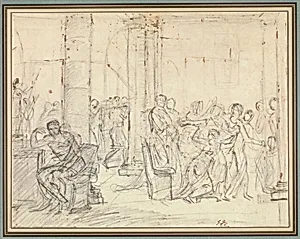
Study for The Lictors Bringing Brutus the Bodies of his Sons
ca. 1788
Medium
Black chalk and brown ink on paper
Dimensions
9 7/16 x 12 1/8 in. (23.9 x 30.8 cm)
Classification
Drawings
Department
Robert Lehman Collection
Museum
Metropolitan Museum of Art, New York, NY
Credit
Robert Lehman Collection, 1975
Accession Number
1975.1.607
Rights
Public Domain
Tags
Art Historical Context
This delicate drawing, *Study for The Lictors Bringing Brutus Bodies of his Sons*ca. 1788), by Jacques-Louis David, offers a poignant glimpse into the preparatory process for one of the artist's most iconic Neoclassical masterpieces. Created in black chalk and brown ink on, it captures human figures in a moment of profound sadness,oking the ancient Roman story of Lucius Junius Brutus As a founder of the Roman Republic, Brutus ordered the execution of his own sons for plotting against it, a tale of stern civic duty over paternal love that resonated deeply in late 18th-century France. David, a leading figure of Neoclassicism, drew inspiration from classical antiquity to champion revolutionary ideals of virtue and sacrifice. This study, measuring just 9 7/16 x 12 1/8 inches, previews the dramatic composition of his 1789 painting, now in the Louvre. The intimate scale and fluid lines highlight David's meticulous technique, blending precise contours with subtle shading to convey emotional depth—Brutus's stoic resolve contrasting the grief of the women. Housed in the Metropolitan Museum of Art's Robert Lehman Collection, this work underscores the artist's rigorous preparatory methods, bridging the gap between sketch and grand canvas. It invites visitors to appreciate how such studies fueled the moral intensity of Neoclassical art on the eve of the French Revolution.
About the Artist
Jacques Louis David · 1748–1825
Jacques-Louis David (1748–1825), born in Paris on August 30 to a prosperous family, faced early tragedy when his father was killed in a duel around age nine. Raised by his mother's two architect uncles after his mother departed, David overcame family resistance to architecture and a facial tumor that hindered his speech and studies at the Collège des Quatre-Nations. He began training under the Roc...