
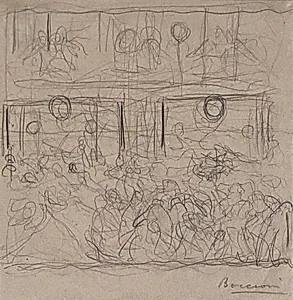
Study for "The Riot"
1910
Medium
Graphite on paper
Dimensions
6 1/4 × 6 1/8 in. (15.9 × 15.6 cm)
Classification
Drawings
Department
Modern and Contemporary Art
Museum
Metropolitan Museum of Art, New York, NY
Credit
Bequest of Lydia Winston Malbin, 1989
Accession Number
1990.38.19
Rights
Public Domain
Art Historical Context
Umberto Boccioni’s 1910 graphite drawing *Study for “The Riot”* captures a fleeting moment of social turbulence with remarkable economy. Created at the dawn of the Futurist movement, which Boccioni helped shape, the small sheet reflects the artist’s fascination with the energy of modern crowds and the speed of contemporary life. Though only 6¼ by 6⅛ inches, the study distills the raw power of a street confrontation into swirling lines and urgent marks that suggest bodies in motion. As a preparatory work on paper, the drawing reveals Boccioni’s working method—quick, gestural strokes that prioritize feeling over finish. Graphite’s immediacy allowed him to experiment with fragmented forms and directional force, techniques that would later define his groundbreaking Futurist paintings and sculptures. Visitors can sense the artist testing how to convey collective emotion through abstract rhythm rather than literal detail. Housed in the Metropolitan Museum of Art through the bequest of Lydia Winston Malbin, this intimate study offers a rare glimpse into the creative process behind one of the early twentieth century’s most dynamic artistic visions. It reminds us that even revolutionary ideas often begin with a pencil and a sheet of paper.
About the Artist
Umberto Boccioni · 1882–1916
Umberto Boccioni (1882–1916) was an Italian painter and sculptor who became the leading artist and principal theorist of the Futurist movement. Born in Reggio Calabria, he studied in Rome under the Divisionist painter Giacomo Balla and was deeply influenced by Post-Impressionism before encountering the ideas of Filippo Tommaso Marinetti, whose 1909 Futurist Manifesto catalyzed Boccioni's artistic ...