
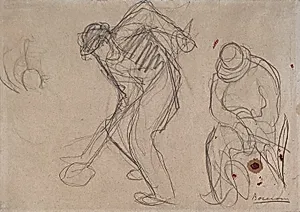
Study for "The Street Pavers": Two Workmen
1914
Medium
Graphite and ink on paper
Dimensions
5 1/2 × 8 3/16 in. (13.9 × 20.8 cm)
Classification
Drawings
Department
Modern and Contemporary Art
Museum
Metropolitan Museum of Art, New York, NY
Credit
Bequest of Lydia Winston Malbin, 1989
Accession Number
1990.38.28
Rights
Public Domain
Tags
Art Historical Context
**Study for "The Street Pavers": Workmen** Umberto Boccioni, 1914 Graphite and ink on paper, 5 1/2 × 8 3/16 in. (13.9 × 20.8 cm) Step into the dynamic world of Italian Futurism with this drawing by Umberto Boccioni, a figure in the movement that revolutionized early 20th-century art. Created in 1914, just as Europe teetered on the brink of World War, this preparatory study captures two workmen in a moment of urban labor. Boccioni, who co-authored the Futurist Manifesto in 1910, sought to depict the energy of modern life—machines, speed, and the vitality of the working class—through fragmented forms and implied motion, breaking away from traditional static representation. Rendered in graphite and ink on paper, the modest scale invites close inspection, revealing Boccioni's rapid, expressive lines that sketch the figures' poses and tools with urgent precision. As a study for the larger painting *The Street Pavers*, it offers a rare glimpse into the artist's process, where ideas for monumental canvases began in quick, gestural drawings. This technique underscores Futurism's emphasis on simultaneity, blending past and future in everyday scenes. Now housed in the Metropolitan Museum of Art's Modern and Contemporary Art department through the bequest of Lydia Winston Malbin in 1989, this work celebrates human figures at the heart of industrial progress, reminding us how Boccioni transformed mundane laborers into symbols of modernity's relentless drive. (218 words)
About the Artist
Umberto Boccioni · 1882–1916
Umberto Boccioni (1882–1916) was an Italian painter and sculptor who became the leading artist and principal theorist of the Futurist movement. Born in Reggio Calabria, he studied in Rome under the Divisionist painter Giacomo Balla and was deeply influenced by Post-Impressionism before encountering the ideas of Filippo Tommaso Marinetti, whose 1909 Futurist Manifesto catalyzed Boccioni's artistic ...