
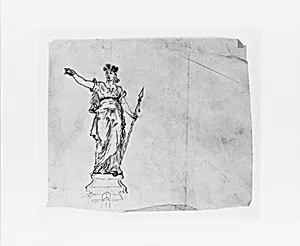
Study for Victory (from Sketchbook)
ca. 1860
Medium
Graphite on paper
Dimensions
5 5/8 × 6 7/8 in. (14.3 × 17.5 cm)
Classification
Drawing
Culture
American
Department
The American Wing
Museum
Metropolitan Museum of Art, New York, NY
Credit
Gift of Edward R. Grove, 1985
Accession Number
1985.351.5 recto
Rights
Public Domain
Tags
Art Historical Context
In the American Wing of the Metropolitan Museum Art, *Study for Victory (frombook)* by John Quincy Adams Ward offers glimpse into the creative process of one of 19th-century America's leading sculptors. Dated around 1860, this intimate graphite drawing on paper (5 5/8 × 6 7/8 in.) captures Ward preparatory work for a larger sculptural project featuring the allegorical figure of Victory. Ward, renowned for his neoclassical monuments like the *Indian Hunter* and civic statues, often began with such sketchbook studies to refine poses and compositions, blending classical ideals with emerging American realism. Graphite's versatility shines here, allowing Ward to sketch fluid lines and subtle shading on modest paper, a practical medium for artists working toward monumental bronze or marble works. This technique highlights the humility of the sketchbook as a private workspace, contrasting the grandeur of public sculpture. Created on the eve of the Civil War, the theme of Victory resonates with national aspirations for triumph amid turmoil. Donated in 1985 by Edward R. Grove, this modest gem invites visitors to appreciate the thoughtful groundwork behind enduring American icons.
About the Artist
John Quincy Adams Ward · 1830–1910
John Quincy Adams Ward (1830–1910) was born in Urbana, Ohio, the fourth of eight children, and displayed an early aptitude for three-dimensional form, modeling figures in clay from childhood. In 1849 he moved to Brooklyn, New York, to apprentice under the sculptor Henry Kirke Brown, with whom he worked for seven years. Brown's emphasis on American subjects and his conviction that sculpture should ...