
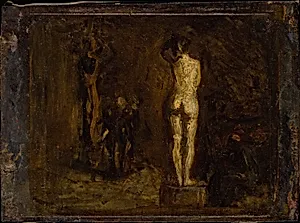
Study for "William Rush Carving His Allegorical Figure of the Schuylkill River"
Classification
Painting
Department
Smithsonian Collection
Museum
Smithsonian American Art Museum
Credit
Hirshhorn Museum and Sculpture Garden, Smithsonian Institution, Washington, DC, Gift of Joseph H. Hirshhorn, 1966
Accession Number
66.1519
Rights
Public Domain
About this artwork
Jh Purchased From Knoedler & Co., Inc., M., New York 1961
Art Historical Context
Thomas Eakins, a pioneering American realist painter born in Philadelphia in 1844, created this *Study for "William Rush Carving His Allegorical of the Schuylkill"* around 1908, late in his career.akins was renowned for his unflinching depictions of everyday life, anatomy, and the labor of artists, drawing from his studies in medicine and photography to unprecedented realism. This preparatory captures the 19th-century sculptor William Rush at work on a wooden allegorical figure for Philadelphia'smount Water Works, honoring a fellow local artist from the early American republic. As a study, the work reveals Eakins' meticulous process, likely exploring composition, lighting, and anatomical detail before the final canvas now in the Philadelphia Museum of Art. Rush (1756–1833), America's first native-born sculptor, symbolized Philadelphia's industrial and cultural growth with his neoclassical figures for the Schuylkill River intake pipes, blending utility and artistry. Housed in the Smithsonian American Art Museum's Hirshhorn collection, this piece underscores Eakins' reverence for American craftsmanship and his role in elevating realism as a movement. It invites visitors to appreciate the quiet heroism of creation, bridging 18th-century sculpture with 20th-century innovation.