
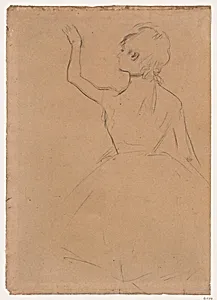
Study of a Ballet Dancer seen from the Back
1875 (?)
Medium
Black chalk on faded pink wove paper
Dimensions
12 1/8 x 8 9/16 in. (30.8 x 21.8 cm)
Classification
Drawings
Department
Robert Lehman Collection
Museum
Metropolitan Museum of Art, New York, NY
Credit
Robert Lehman Collection, 1975
Accession Number
1975.1.608
Rights
Public Domain
Tags
Art Historical Context
In the mid-1870s, Edgar Degas captured the graceful form of a ballet dancer in this intimate study, *Study of a Ballet Dancer from the Back*. Rendered in black chalk on faded pinkove paper, the drawing measures a modest 12 1/8 x 8 9/16 inches, highlighting Degas's mastery of preparatory sketches. As a key figure in Impressionism—though he rejected the label—Degas frequented Paris's Opéra ballet studios, sketching dancers in unguarded moments to explore movement and the female form with unflinching realism. The rear view emphasizes the dancer's poised musculature and costume details, a technique Degas used to convey immediacy and anatomy without idealization. Black chalk on tinted paper creates subtle tonal contrasts, evoking the soft lighting of rehearsal spaces and foreshadowing his later pastel innovations. This work reflects 19th-century Parisian fascination with ballet as both high art and working-class spectacle, where women like these *petits rats* embodied modernity. Now in the Robert Lehman Collection at The Metropolitan Museum of Art since 1975, this drawing exemplifies Degas's hundreds of ballet studies, offering visitors a window into his obsessive process and enduring cultural iconography of the dancer.
About the Artist
Edgar Degas · 1834–1917
Edgar Degas (1834-1917) stands as one of the most innovative artists of the nineteenth century, whose distinctive vision transformed how modern life could be depicted on canvas. Born Hilaire-Germain-Edgar De Gas in Paris to a wealthy banking family—his father French, his mother a Louisiana Creole from New Orleans—Degas received a classical education before abandoning law studies in 1855 to pursue ...